
Making Native Space


Zusammenfassung
The feel-good place to buy books
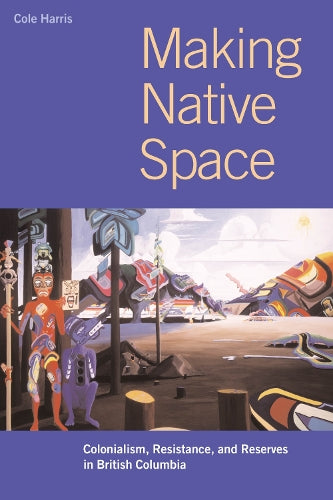
Making Native Space by Cole Harris
This elegantly written and insightful book provides a geographical history of the Indian reserve in British Columbia. Cole Harris analyzes the impact of reserves on Native lives and livelihoods and considers how, in light of this, the Native land question might begin to be resolved. The account begins in the early nineteenth-century British Empire and then follows Native land policy - and Native resistance to it - in British Columbia from the Douglas treaties in the early 1850s to the formal transfer of reserves to the Dominion in 1938.
As the first comprehensive account of the reserve system in British Columbia, the book is an important contribution to regional history, the history of aboriginal-white relations, and colonialismPerhaps most unexpectedly, because it puts aboriginal-white relations in the context of the federal-provincial wrangling that has shaped the Canadian political landscape since 1867, it also manages to breathe new life into an old historical chestnut. -- Tina Loo * American Historical Review, April 2003 *
This is a wonderful, timely, thoughtful, and gracefully written book. It makes a highly significant contribution, both to scholarship and to public policy. -- Hamar Foster, Faculty of Law, University of Victoria, author of English Law, British Columbia: Establishing Legal Institutions West of the Rockies and The White Man’s Law in the Far West: Establishing Legal Institutions in British Columbia
Cole Harris has written the definitive history of the Aboriginal struggle for recognition and justice in British Columbia. Future generations of British Columbians, Aboriginal and otherwise, will thank him for this remarkable story. -- Neil J. Sterritt, Gitksan Nation, co-author of Tribal Boundaries in the Nass Watershed
Along with its encyclopaedic account of the white geographies and mentalities that dominated British Columbia through the 1800s and 1900s, Making Native Space is also a compelling saga of Aboriginal management and resistance. -- Robert Menzies * Canadian Journal of Law and Society, Vol. 18, No. 1 *
Cole Harris’s latest book is a well crafted, handsomely produced historical geography ... It is rich in terms of its colonial discourse analysis, its comparative insight and its engagement with the politics of postcolonialism. -- Alan Lester, University of Sussex * Area, Vol. 35, Issue 3, September 2003 *
This is an important book for historians, geographers, lawyers, government officials, and scholars of Aboriginal studies. But it deserves to reach a wider audience because it speaks to fundamental issues of Canada’s founding, namely, the dispossession of the original peoples living here ... Harris has given us a remarkable book, a genealogy, in the Foucauldian sense, of reserve policy and the land question in BC today. -- Jean-Paul Restoule * University of Toronto Quarterly, Winter 2004/05 *
Outstanding ... invites us to rethink, and remap, literally and figuratively, the boundaries and paths that can guide us to a brighter future. -- Karl Preuss, University of Victoria * American Indian Quarterly, Summer & Fall 2005, Vol. 29, Nos. 3 and 4 *
This is a wonderful, timely, thoughtful, and gracefully written book. It makes a highly significant contribution, both to scholarship and to public policy. -- Hamar Foster, Faculty of Law, University of Victoria, author of English Law, British Columbia: Establishing Legal Institutions West of the Rockies and The White Man’s Law in the Far West: Establishing Legal Institutions in British Columbia
Cole Harris has written the definitive history of the Aboriginal struggle for recognition and justice in British Columbia. Future generations of British Columbians, Aboriginal and otherwise, will thank him for this remarkable story. -- Neil J. Sterritt, Gitksan Nation, co-author of Tribal Boundaries in the Nass Watershed
Along with its encyclopaedic account of the white geographies and mentalities that dominated British Columbia through the 1800s and 1900s, Making Native Space is also a compelling saga of Aboriginal management and resistance. -- Robert Menzies * Canadian Journal of Law and Society, Vol. 18, No. 1 *
Cole Harris’s latest book is a well crafted, handsomely produced historical geography ... It is rich in terms of its colonial discourse analysis, its comparative insight and its engagement with the politics of postcolonialism. -- Alan Lester, University of Sussex * Area, Vol. 35, Issue 3, September 2003 *
This is an important book for historians, geographers, lawyers, government officials, and scholars of Aboriginal studies. But it deserves to reach a wider audience because it speaks to fundamental issues of Canada’s founding, namely, the dispossession of the original peoples living here ... Harris has given us a remarkable book, a genealogy, in the Foucauldian sense, of reserve policy and the land question in BC today. -- Jean-Paul Restoule * University of Toronto Quarterly, Winter 2004/05 *
Outstanding ... invites us to rethink, and remap, literally and figuratively, the boundaries and paths that can guide us to a brighter future. -- Karl Preuss, University of Victoria * American Indian Quarterly, Summer & Fall 2005, Vol. 29, Nos. 3 and 4 *
Cole Harris recently retired as a member of the Department of Geography at the University of British Columbia and is the author or editor of many books about British Columbia and Canada, including The Historical Atlas of Canada, Volume 1, for which he was the editor, and The Resettlement of British Columbia: Essays on Colonialism and Geographical Change.
| SKU | Nicht verfügbar |
| ISBN 13 | 9780774809016 |
| ISBN 10 | 0774809019 |
| Titel | Making Native Space |
| Autor | Cole Harris |
| Serie | Brenda And David Mclean Canadian Studies |
| Buchzustand | Nicht verfügbar |
| Bindungsart | Paperback |
| Verlag | University of British Columbia Press |
| Erscheinungsjahr | 2003-01-01 |
| Seitenanzahl | 448 |
| Preise | Winner of Clio Award (British Columbia), Canadian Historical Association 2003 (Canada), Winner of Sir John A. Macdonald Prize, Canadian Historical Association 2003 (Canada), Winner of Massey Medal, Royal Canadian Geographical Society 2003 (Canada), Short-listed for Hubert Evans Non-Fiction Book Prize, British Columbia Book Awards 2002 (Canada) |
| Hinweis auf dem Einband | Die Abbildung des Buches dient nur Illustrationszwecken, die tatsächliche Bindung, das Cover und die Auflage können sich davon unterscheiden. |
| Hinweis | Nicht verfügbar |