
Math Through the Ages


Zusammenfassung
The feel-good place to buy books
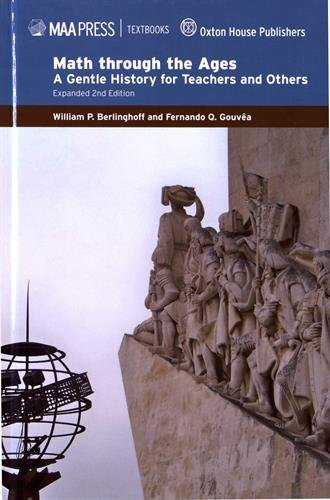
Math Through the Ages by William P Berlinghoff
Where did maths come from? Who thought up all those algebra symbols, and why? What's the story behind ... negative numbers? ... the metric system? ... quadratic equations? ... sine and cosine? The 25 independent sketches in Math through the Ages answer these questions and many others in an informal, easygoing style that's accessible to teachers, students, and anyone who is curious about the history of mathematical ideas. Each sketch contains Questions and Projects to help you learn more about its topic and to see how its main ideas fit into the bigger picture of history. The 25 short stories are preceded by a 56-page bird's-eye overview of the entire panorama of mathematical history, a whirlwind tour of the most important people, events, and trends that shaped the mathematics we know today. Reading suggestions after each sketch provide starting points for readers who want to pursue a topic further.
This is a beautiful and important book, a pleasure to read, in which the history recounted fully illuminates the mathematical ideas, and the ideas themselves are superbly explained: a wonderful accomplishment" - Barry Mazur, Harvard University
"Math through the Ages is a treasure, one of the best history of math books at its level ever written. Somehow, it manages to stay true to a surprisingly sophisticated story, while respecting the needs of its audience." - Glen van Brummelen, Quest University President (2012.14), Canadian Society for History and Philosophy of Mathematics
"Math through the Ages is a treasure, one of the best history of math books at its level ever written. Somehow, it manages to stay true to a surprisingly sophisticated story, while respecting the needs of its audience." - Glen van Brummelen, Quest University President (2012.14), Canadian Society for History and Philosophy of Mathematics
William Berlinghoff was educated at the College of the Holy Cross, Boston College, and Wesleyan University, where he received his PhD in Mathematics. He began his teaching career at the College of St Rose in Albany, New York, was Professor of Mathematics at Southern Connecticut State University, and was Visiting Professor of Mathematics at Colby College in Waterville, Maine. He regularly taught a mathematics course for liberal arts students that drew heavily on the historical development of the subject. He is the author or a co-author of several college texts for liberal arts mathematics, including A Mathematics Sampler (5th edition, 2001). He was also a Senior Writer for MATH Connections, a Standards-based secondary school core curriculum. Fernando Q. Gouvêa was educated at the University of Sao Paulo and at Harvard University, where he received his PhD in Mathematics. He is Carter Professor of Mathematics at Colby College, where he teaches, among other things, a course on the history of mathematics. He was a participant in the Institute for the History of Mathematics and its Use in Teaching, organized by the Mathematical Association of America. Fernando was the editor of MAA Focus from 1999 to 2010, and he is now editor of MAA Reviews and of the Carus Mathematical Monographs series. In addition to this book, he has written p-adic Numbers: An Introduction (2nd edition, 1997), A Guide to Groups, Rings, and Fields (2012) and several other books, research papers, and expository articles.
| SKU | Nicht verfügbar |
| ISBN 13 | 9781939512123 |
| ISBN 10 | 1939512123 |
| Titel | Math Through the Ages |
| Autor | William P Berlinghoff |
| Buchzustand | Nicht verfügbar |
| Bindungsart | Hardback |
| Verlag | Mathematical Association of America |
| Erscheinungsjahr | 2016-02-25 |
| Seitenanzahl | 342 |
| Hinweis auf dem Einband | Die Abbildung des Buches dient nur Illustrationszwecken, die tatsächliche Bindung, das Cover und die Auflage können sich davon unterscheiden. |
| Hinweis | Nicht verfügbar |