
Mathematica for Theoretical Physics


Mathematica for Theoretical Physics
Zusammenfassung
As physicists, mathematicians or engineers, we are all involved with mathematical calculations in our everyday work. Mathematica not only supports popular numerical calculations but also enables us to do exact analytical calculations by computer.
The feel-good place to buy books
- Free delivery in the UK
- Supporting authors with AuthorSHARE
- 100% recyclable packaging
- B Corp - kinder to people and planet
- Buy-back with World of Books - Sell Your Books
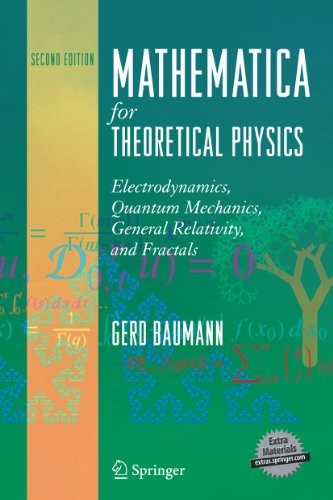
Mathematica for Theoretical Physics by Gerd Baumann
As physicists, mathematicians or engineers, we are all involved with mathematical calculations in our everyday work. Most of the laborious, complicated, and time-consuming calculations have to be done over and over again if we want to check the validity of our assumptions and derive new phenomena from changing models. Even in the age of computers, we often use paper and pencil to do our calculations. However, computer programs like Mathematica have revolutionized our working methods. Mathematica not only supports popular numerical calculations but also enables us to do exact analytical calculations by computer. Once we know the analytical representations of physical phenomena, we are able to use Mathematica to create graphical representations of these relations. Days of calculations by hand have shrunk to minutes by using Mathematica. Results can be verified within a few seconds, a task that took hours if not days in the past. The present text uses Mathematica as a tool to discuss andto solve examples from physics. The intention of this book is to demonstrate the usefulness of Mathematica in everyday applications. We will not give a complete description of its syntax but demonstrate by examples the use of its language. In particular, we show how this modern tool is used to solve classical problems. viii Preface This second edition of Mathematica in Theoretical Physics seeks to prevent the objectives and emphasis of the previous edition.From the reviews of the second edition:
"The new edition contains a lot of additional material and new examples, and more emphasis is put on an interactive problem solvingIn particular, advantage is taken of many special functions and frequently used operations which are available in Mathematica, in order to demonstrate how Mathematica can be used to replace lengthy ‘by-hand’ calculations and to give graphical support." (M. Plum, Zentralblatt MATH, Vol. 1095 (21), 2006)
The Author, Gerd Baumann, is affiliated with the Mathematical Physics Division of the University of Ulm, Germany, where he is professor. He is the author of Symmetry Analysis of Differential Equations with Mathematica®. Dr. Baumann has given numerous invited talks at universities and industry alike. He regularly hosts seminars and lectures on symbolic computing at the University of Ulm and at TECHNISCHE UNIVERSITÄT MÜNCHEN (TUM), Munich.
| SKU | Nicht verfügbar |
| ISBN 13 | 9780387219332 |
| ISBN 10 | 0387219331 |
| Titel | Mathematica for Theoretical Physics |
| Autor | Gerd Baumann |
| Buchzustand | Nicht verfügbar |
| Verlag | Springer-Verlag New York Inc. |
| Erscheinungsjahr | 2005-08-16 |
| Seitenanzahl | 400 |
| Hinweis auf dem Einband | Die Abbildung des Buches dient nur Illustrationszwecken, die tatsächliche Bindung, das Cover und die Auflage können sich davon unterscheiden. |
| Hinweis | Nicht verfügbar |