
Mathematics and the Physical World


Proud to be B-Corp
The feel-good place to buy books
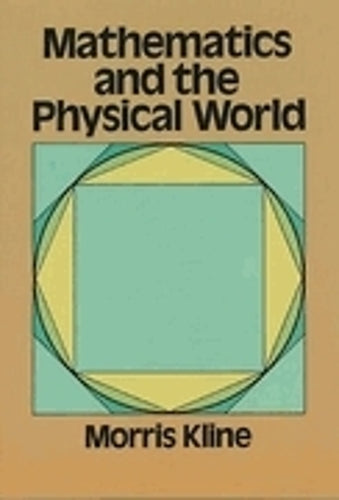
Mathematics and the Physical World by Morris Kline
Kline is a first-class teacher and an able writer. . . . This is an enlarging and a brilliant book. ― Scientific AmericanDr. Morris Kline has succeeded brilliantly in explaining the nature of much that is basic in math, and how it is used in science. ― San Francisco ChronicleSince the major branches of mathematics grew and expanded in conjunction with science, the most effective way to appreciate and understand mathematics is in terms of the study of nature. Unfortunately, the relationship of mathematics to the study of nature is neglected in dry, technique-oriented textbooks, and it has remained for Professor Morris Kline to describe the simultaneous growth of mathematics and the physical sciences in this remarkable book. In a manner that reflects both erudition and enthusiasm, the author provides a stimulating account of the development of basic mathematics from arithmetic, algebra, geometry, and trigonometry, to calculus, differential equations, and the non-Euclidean geometries. At the same time, Dr. Kline shows how mathematics is used in optics, astronomy, motion under the law of gravitation, acoustics, electromagnetism, and other phenomena. Historical and biographical materials are also included, while mathematical notation has been kept to a minimum.
This is an excellent presentation of mathematical ideas from the time of the Greeks to the modern era. It will be of great interest to the mathematically inclined high school and college student, as well as to any reader who wants to understand ― perhaps for the first time ― the true greatness of mathematical achievements.
Morris Kline: Mathematics for the Masses
Morris Kline (1908-1992) had a strong and forceful personality which he brought both to his position as Professor at New York University from 1952 until his retirement in 1975, and to his role as the driving force behind Dover's mathematics reprint program for even longer, from the 1950s until just a few years before his death. Professor Kline was the main reviewer of books in mathematics during those years, filling many file drawers with incisive, perceptive, and always handwritten comments and recommendations, pro or con. It was inevitable that he would imbue the Dover math program ― which he did so much to launch ― with his personal point of view that what mattered most was the quality of the books that were selected for reprinting and the point of view that stressed the importance of applications and the usefulness of mathematics. He urged that books should concentrate on demonstrating how mathematics could be used to solve problems in the real world, not solely for the creation of intellectual structures of theoretical interest to mathematicians only.
Morris Kline was the author or editor of more than a dozen books, including Mathematics in Western Culture (Oxford, 1953), Mathematics: The Loss of Certainty (Oxford, 1980), and Mathematics and the Search for Knowledge (Oxford, 1985). His Calculus, An Intuitive and Physical Approach, first published in 1967 and reprinted by Dover in 1998, remains a widely used text, especially by readers interested in taking on the sometimes daunting task of studying the subject on their own. His 1985 Dover book, Mathematics for the Nonmathematician could reasonably be regarded as the ultimate math for liberal arts text and may have reached more readers over its long life than any other similarly directed text.
In the Author's Own Words:
Mathematics is the key to understanding and mastering our physical, social and biological worlds.
Logic is the art of going wrong with confidence.
Statistics: the mathematical theory of ignorance.
A proof tells us where to concentrate our doubts. ― Morris Kline
| SKU | Nicht verfügbar |
| ISBN 13 | 9780486241043 |
| ISBN 10 | 0486241041 |
| Titel | Mathematics and the Physical World |
| Autor | Morris Kline |
| Buchzustand | Nicht verfügbar |
| Bindungsart | Paperback |
| Verlag | Dover Publications Inc. |
| Erscheinungsjahr | 2003-03-28 |
| Seitenanzahl | 496 |
| Hinweis auf dem Einband | Die Abbildung des Buches dient nur Illustrationszwecken, die tatsächliche Bindung, das Cover und die Auflage können sich davon unterscheiden. |
| Hinweis | Nicht verfügbar |