
Medieval Thought


Medieval Thought
Regular price
Checking stock...
Regular price
Checking stock...
Zusammenfassung
The Middle Ages span a period of well over a millennium. This text steers a path through this long period, and gives an insight into medieval views on aspects such as astronomy, materialism, perception and the nature of the soul.
The feel-good place to buy books
- Free delivery in the UK
- Supporting authors with AuthorSHARE
- 100% recyclable packaging
- B Corp - kinder to people and planet
- Buy-back with World of Books - Sell Your Books
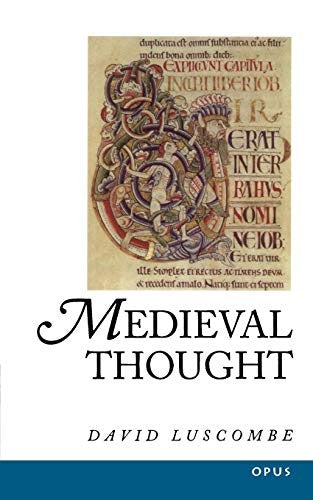
Medieval Thought by David Luscombe
The Middle Ages span a period of well over a millennium: from the emperor Constantine's Christian conversion in 312 to the early sixteenth century. During this time there was remarkable continuity of thought, but there were also many changes made in different philosophies: various breaks, revivals, and rediscoveries. David Luscombe's history of Medieval Thought steers a clear path through this long period, beginning with the three greatest influences on medieval philosophy: Augustine, Boethius, and Pseudo-Denis, and focusing on Alcuin, Abelard, Anselm, Aquinas, Ockham, Duns Scotus, and Eckhart amongst others in the twelfth to fifteenth centuries. Medieval philosophy is widely regarded as having a theological and religious orientation, but more recently attention has been given to the early study of logic, language, and the philosophy of science. This history therefore gives a fascinating insight into medieval views on aspects such as astronomy, materialism, perception, and the nature of the soul.
David Luscombe is a Professor in the Department of History at the University of Sheffield.
| SKU | Nicht verfügbar |
| ISBN 13 | 9780192891792 |
| ISBN 10 | 0192891790 |
| Titel | Medieval Thought |
| Autor | David Luscombe |
| Serie | A History Of Western Philosophy |
| Buchzustand | Nicht verfügbar |
| Bindungsart | Paperback |
| Verlag | Oxford University Press |
| Erscheinungsjahr | 1997-04-24 |
| Seitenanzahl | 256 |
| Hinweis auf dem Einband | Die Abbildung des Buches dient nur Illustrationszwecken, die tatsächliche Bindung, das Cover und die Auflage können sich davon unterscheiden. |
| Hinweis | Nicht verfügbar |