
Oceanographers and the Cold War


Proud to be B-Corp
The feel-good place to buy books
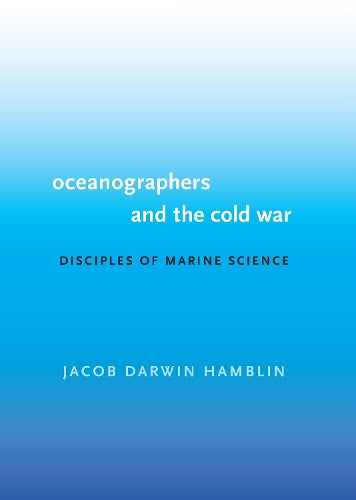
Oceanographers and the Cold War by Jacob Darwin Hamblin
A political history of twentieth-century oceanographyOceanographers and the Cold War is about patronage, politics, and the community of scientists. It is the first book to examine the study of the oceans during the Cold War era and explore the international focus of American oceanographers, taking into account the roles of the US Navy, US foreign policy, and scientists throughout the world. Jacob Darwin Hamblin demonstrates that to understand the history of American oceanography, one must consider its role in both conflict and cooperation with other nations. Paradoxically, American oceanography after World War II was enmeshed in the military-industrial complex while characterized by close international cooperation. The military dimension of marine science--with its involvement in submarine acoustics, fleet operations, and sea-launched nuclear missiles--coexisted with data exchange programs with the Soviet Union and global operations in seas without borders. From an uneasy cooperation with the Soviet bloc in the International Geophysical Year of 1957-58, to the NATO Science Committee in the late 1960s, which excluded the Soviet Union, to the US Marine Sciences Council, which served as an important national link between scientists and the government, Oceanographers and the Cold War reveals the military and foreign policy goals served by US government involvement in cooperative activities between scientists, such as joint cruises and expeditions. It demonstrates as well the extent to which oceanographers used international cooperation as a vehicle to pursue patronage from military, government, and commercial sponsors during the Cold War, as they sought support for their work by creating "disciples of marine science" wherever they could.A political history of twentieth-century oceanography"Oceanographers and the Cold War is of tremendous value, as it challenges readers, and other historians, to take into account not just the national background of various marine scientific enterprises, but international issues and the overarching political themes of an era, which affect how science is done"
* History of Philosophical and Life Sciences *"The lessons embedded in this narrative continue to resonate in a contemporary world which looks quite different, even as the meanings of Cold War contexts, marine environmental science, and international collaboration evolve for a new era."
* H-Net *"[This] book is the first to provide a deeply researched, historically sound, insightful and provocative view of how military goals, scientific motivations and global political forces interacted in the growth of oceanography between the end of World War II and the 1970s."
* The Journal of Military History *Jacob Darwin Hamblin is professor of history at Oregon State University. He is the author of several books, including The Wretched Atom: America's Global Gamble with Peaceful Nuclear Technology and Poison in the Well: Radioactive Waste in the Oceans at the Dawn of the Nuclear Age.
| SKU | Nicht verfügbar |
| ISBN 13 | 9780295751276 |
| ISBN 10 | 0295751274 |
| Titel | Oceanographers and the Cold War |
| Autor | Jacob Darwin Hamblin |
| Serie | Oceanographers And The Cold War |
| Buchzustand | Nicht verfügbar |
| Bindungsart | Paperback |
| Verlag | University of Washington Press |
| Erscheinungsjahr | 2022-09-13 |
| Seitenanzahl | 368 |
| Hinweis auf dem Einband | Die Abbildung des Buches dient nur Illustrationszwecken, die tatsächliche Bindung, das Cover und die Auflage können sich davon unterscheiden. |
| Hinweis | Nicht verfügbar |