
Ordinary Differential Equations


Zusammenfassung
The feel-good place to buy books
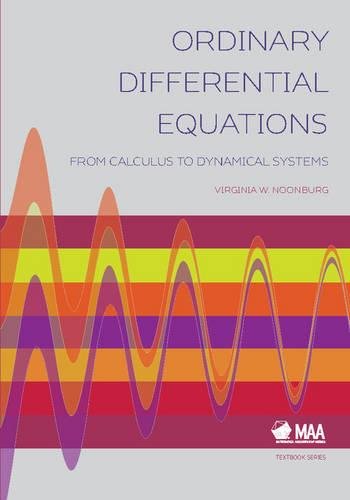
Ordinary Differential Equations by Virginia W Noonburg
Techniques for studying ordinary differential equations (ODEs) have become part of the required toolkit for students in the applied sciences. This book presents a modern treatment of the material found in a first undergraduate course in ODEs. Standard analytical methods for first- and second-order equations are covered first, followed by numerical and graphical methods, and bifurcation theory. Higher dimensional theory follows next via a study of linear systems of first-order equations, including background material in matrix algebra. A phase plane analysis of two-dimensional nonlinear systems is a highlight, while an introduction to dynamical systems and an extension of bifurcation theory to cover systems of equations will be of particular interest to biologists. With an emphasis on real-world problems, this book is an ideal basis for an undergraduate course in engineering and applied sciences such as biology, or as a refresher for beginning graduate students in these areas.
This is a textbook that could be used for a standard undergraduate course in ordinary differential equationsIt is substantially cheaper than most of the alternatives from commercial publishers, it is well-written, and it appears to have been carefully proofread. The target audience seems to be students whose background in mathematics is ot particularly strong. No prior exposure to linear algebra is assumed. When the method of partial fractions is used to invert Laplace transforms, this method is presented in substantial detail. The balance between computation and theory seems tilted more towards the former than in competing texts. In the back of the book, solutions-not just final answers-are provided for all odd-numbered exercises. The approach is modern in the sense that computer algebra systems are presented as important tools for the student, and also in the sense that geometric treatment of nonlinear equations gets substantial attention."" - Christopher P. Grant, Mathematical Review Clippings
""Although Noonburg's book is slim, it covers (and covers well) all of the familiar topics one expects to find in a first semester sophomore-level ODE course, and then some. It also has some interesting features that distinguish it from most of the existing textbook literature, chief among them being a strong emphasis on the dynamical systems approach, which manifests itself in, for example, an early introduction to the idea of a system of differential equations, as well as an early introduction to the concept of the phase line and phase plane for autonomous first and second order ODEs. ...The author's writing style is very clear and should be quite accessible to most students reading the book. There are lots of worked examples and interesting applications, including some fairly unusual ones. There are also numerous exercises, ranging in difficulty from the very routine (verify that such-and-such function is a solution to such-and-such differential equation) to more elaborate student projects, some of which are based on research papers. Some (carefully marked) exercises require computer assistance. Solutions to the odd-numbered problems appear in a 40 page appendix. ...This book may not be for everyone, simply because it invokes a different approach than is found in many other books. I do think, however, that the way I first learned differential equations as a student in the early 1970s (which, even then, seemed to me to be no more exciting than an endless set of quadratic formula problems) needs to be changed (and is changing). This book offers a clean, concise, modern, reader-friendly, approach to the subject, at a price that won t make an instructor feel guilty about assigning it. It is certainly worth a very serious look."" - Mark Hunacek MAA Reviews
""There's particularly good coverage of beats and resonance, phase plane pictures, the matrix exponential (and its simplicity compared to corresponding eigenvalue/eigenvector representations), bifurcation, limit cycles, and the Laplace transform (which many authors make so simple that it provides no added value). The writing is clear, the problems are good, and the material is well motivated and largely self-contained. Some previous acquaintance with linear algebra would, however, be helpful. In summary, this new book is highly recommended for students anxious to discover new techniques."" - SIAM Review
""Although Noonburg's book is slim, it covers (and covers well) all of the familiar topics one expects to find in a first semester sophomore-level ODE course, and then some. It also has some interesting features that distinguish it from most of the existing textbook literature, chief among them being a strong emphasis on the dynamical systems approach, which manifests itself in, for example, an early introduction to the idea of a system of differential equations, as well as an early introduction to the concept of the phase line and phase plane for autonomous first and second order ODEs. ...The author's writing style is very clear and should be quite accessible to most students reading the book. There are lots of worked examples and interesting applications, including some fairly unusual ones. There are also numerous exercises, ranging in difficulty from the very routine (verify that such-and-such function is a solution to such-and-such differential equation) to more elaborate student projects, some of which are based on research papers. Some (carefully marked) exercises require computer assistance. Solutions to the odd-numbered problems appear in a 40 page appendix. ...This book may not be for everyone, simply because it invokes a different approach than is found in many other books. I do think, however, that the way I first learned differential equations as a student in the early 1970s (which, even then, seemed to me to be no more exciting than an endless set of quadratic formula problems) needs to be changed (and is changing). This book offers a clean, concise, modern, reader-friendly, approach to the subject, at a price that won t make an instructor feel guilty about assigning it. It is certainly worth a very serious look."" - Mark Hunacek MAA Reviews
""There's particularly good coverage of beats and resonance, phase plane pictures, the matrix exponential (and its simplicity compared to corresponding eigenvalue/eigenvector representations), bifurcation, limit cycles, and the Laplace transform (which many authors make so simple that it provides no added value). The writing is clear, the problems are good, and the material is well motivated and largely self-contained. Some previous acquaintance with linear algebra would, however, be helpful. In summary, this new book is highly recommended for students anxious to discover new techniques."" - SIAM Review
Virginia W. Noonburg gained a BA in Mathematics from Cornell University, before spending four years as a computer programmer at the knolls Atomic Power Lab near Schenectady, New York. After returning to Cornell and earning a PhD in Mathematics, she taught first at Vanderbilt University in Nashville, Tennessee and then at the University of Hartford in West Hartford, Connecticut (from which she has recently retired as professor emerita). During the late 1980s she twice taught as a visiting professor at Cornell, and also earned a Cornell MS Eng degree in Computer Science.
| SKU | Nicht verfügbar |
| ISBN 13 | 9781939512048 |
| ISBN 10 | 1939512042 |
| Titel | Ordinary Differential Equations |
| Autor | Virginia W Noonburg |
| Serie | Mathematical Association Of America Textbooks |
| Buchzustand | Nicht verfügbar |
| Bindungsart | Hardback |
| Verlag | Mathematical Association of America |
| Erscheinungsjahr | 2015-08-20 |
| Seitenanzahl | 334 |
| Hinweis auf dem Einband | Die Abbildung des Buches dient nur Illustrationszwecken, die tatsächliche Bindung, das Cover und die Auflage können sich davon unterscheiden. |
| Hinweis | Nicht verfügbar |