
Pocketbook Politics


Zusammenfassung
The feel-good place to buy books
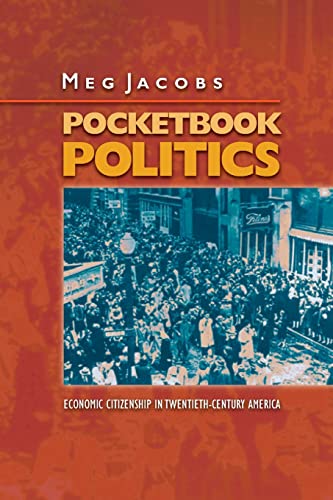
Pocketbook Politics by Meg Jacobs
"How much does it cost?" We think of this question as one that preoccupies the nation's shoppers, not its statesmen. But, as Pocketbook Politics dramatically shows, the twentieth-century American polity in fact developed in response to that very consumer concern. In this groundbreaking study, Meg Jacobs demonstrates how pocketbook politics provided the engine for American political conflict throughout the twentieth century. From Woodrow Wilson to Franklin Roosevelt to Richard Nixon, national politics turned on public anger over the high cost of living. Beginning with the explosion of prices at the turn of the century, every strike, demonstration, and boycott was, in effect, a protest against rising prices and inadequate income. On one side, a reform coalition of ordinary Americans, mass retailers, and national politicians fought for laws and policies that promoted militant unionism, government price controls, and a Keynesian program of full employment. On the other, small businessmen fiercely resisted this low-price, high-wage agenda that threatened to bankrupt them. This book recaptures this dramatic struggle, beginning with the immigrant Jewish, Irish, and Italian women who flocked to Edward Filene's famous Boston bargain basement that opened in 1909 and ending with the Great Inflation of the 1970s. Pocketbook Politics offers a new interpretation of state power by integrating popular politics and elite policymaking. Unlike most social historians who focus exclusively on consumers at the grass-roots, Jacobs breaks new methodological ground by insisting on the centrality of national politics and the state in the nearly century-long fight to fulfill the American Dream of abundance.
Winner of the 2006 Ellis WHawley Prize, Organization of American Historians Winner of the 2006 New England Historical Association Book Prize, New England Historical Association "Meg Jacobs strides boldly through the shards of the old, broken narrative and, with her eye on previously overlooked actors and events, constructs a new story of the rise and fall of the New Deal order. This extraordinary work offers a fresh narrative about American liberalism... [O]ne of the most important pieces of political history this decade."--Jennifer Mittelstadt, Reviews in American History "Meg Jacobs offers a fresh and persuasive interpretation of major policy developments in the early twentieth century. Pocketbook Politic is a key addition to the growing literature in which the study of consumption promotes synthesis in historical scholarship."--Liette Gidlow, The Journal of American History "It is a tribute to this first-rate study that it opens up ... fundamental issues in exciting new ways. Every serious student of modern U.S. political history and political economy will profit from reading Jacobs's path-breaking scholarship."--Robert Collins, EH.NET "This unapologetic political history [is] refreshingly direct, revealing, and persuasive. It should become a standard text for students of the period."--Gary Cross, Business History Review
Meg Jacobs is Associate Professor of American History at the Massachusetts Institute of Technology, She is the co-editor of "The Democratic Experiment: New Directions in American Political History" (Princeton).
| SKU | Nicht verfügbar |
| ISBN 13 | 9780691130415 |
| ISBN 10 | 0691130418 |
| Titel | Pocketbook Politics |
| Autor | Meg Jacobs |
| Serie | Politics And Society In Modern America |
| Buchzustand | Nicht verfügbar |
| Bindungsart | Paperback |
| Verlag | Princeton University Press |
| Erscheinungsjahr | 2007-03-12 |
| Seitenanzahl | 368 |
| Preise | Winner of New England Historical Association Book Award 2006 |
| Hinweis auf dem Einband | Die Abbildung des Buches dient nur Illustrationszwecken, die tatsächliche Bindung, das Cover und die Auflage können sich davon unterscheiden. |
| Hinweis | Nicht verfügbar |