


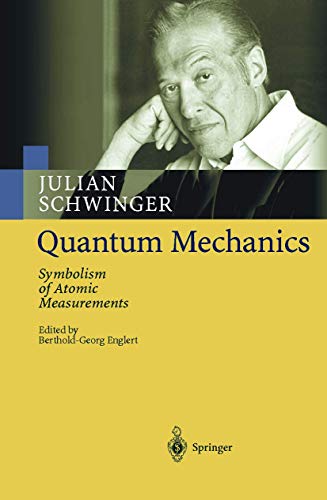
Quantum Mechanics by Julian Schwinger
Julian Schwinger had plans to write a textbook on quantum mechanics since the 1950s when he was teaching the subject at Harvard University regularly. * t Roger Newton remembers: [A] group of us (Stanley Deser, Dick Arnowitt, Chuck Zemach, Paul Martin and I forgot who else) wrote up lecture notes on his Quantum Mechanics course but he never wanted them published because he "had not yet found the perfect way to do quantum mechanics. " The only text of those days that got published eventually - following a sug gestion by, and with the help of, Robert Kohler:!: - were the notes to the lectures that Schwinger presented at Les Houches in 1955. The book was reissued in 1991, with this Special Preface by Schwinger [3]: The first two chapters of this book are devoted to Quantum Kine matics. In 1985 I had the opportunity to review that development in connection with the celebration of the 100th anniversary of Hermann Weyl's birthday. [ . . . ] In presenting my lecture [4] I felt the need to alter only one thing: the notation. Lest one think this rather triv ial, recall that the ultimate abandonment, early in the 19th century, of Newton's method of fluxions in favor of the Leibnizian calculus, stemmed from the greater flexibility of the latter's notation.From the reviews:
"Quantum Mechanics: Symbolism of Atomic Measurements is not just another textbook on quantum mechanicsRather, it contains truly novel elements of both content and style. In particular, Schwinger begins his treatment not with de Broglie waves or the Schrödinger equation but rather with the measurement process. His idea is to derive, or at least make plausible, the formalism of state vectors, bras and kets, by reference to quantum measurements such as the Stern-Gerlach experiment. This [...] is simply the basis of a new way of teaching quantum mechanics. This opening chapter should be of interest to all scholars of quantum theory and might form a new topic of research for philosophers of quantum mechanics." (Contemporary Physics, 44/2, 2003)
"There are dozen of excellent textbooks on the market. But this one really is different." (T. Kibble, The Times Higher Education Supplement, 2001)
"The material covered is superficially similar to that of a typical graduate quantum mechanics course [...] However, each chapter has beautiful and unusual treatments of familiar topics. [...] This book would make an outstanding supplement and reference for a graduate quantum mechanics course. Theoretical physicists will delight in this wonderful book, which should be available in the library system of any institution with a research or graduate program in physics. Graduate students through professionals." (CHOICE, Dec. 2001)
"The book is a tour-de-force. Once the groundwork is laid, he goes into subjects with the mathematical virtuosity for which he was famous – not advanced mathematics, but the incredible use of simple mathematics. … there are gems throughout the book. … it is a wonderful book for a professor to own, like Feyman’s lectures, because there is so much to learn from it. … The book was lovingly edited from some UCLA lecture notes, by Berthold-Georg Englert, a longtime student andassistant of Schwinger’s … ." (Daniel Greenberger, American Journal of Physics, Vol 71 (9), 2003)
"Editor Englert has performed a service for physicists everywhere by making available this book, which is based on Schwinger’s unpublished UCLA lecture notes. … each chapter has beautiful and unusual treatments of familiar topics. … There are excellent problems at the end of each chapter. This book would make an outstanding supplement and reference for a graduate quantum mechanics course. Theoretical physicists will delight in this wonderful book, which should be available in the library system of any institution with a research or graduate program … ." (M. C. Ogilvie, CHOICE, December, 2001)
"The book commences with an absorbing prologue in which Schwinger talks us through the development of quantum mechanic and quantum field theory in an easy conversational style. … The book is packed with exercises for the reader to attempt. … Anyone who works religiously through these exercises will acquire a thoroughly adequate command of quantum mechanics." (W. Cox, Mathematical Reviews, Issue 2002 h)
"Quantum mechanics: Symbolism of Atomic Measurements is not just another textbook on quantum mechanics. Rather, it contains truly novel elements of both content and style. … This opening chapter should be of interest to all scholars of quantum theory and might form a new topic of research for philosophers of quantum mechanics. Throughout the text, new material is presented at a breathless pace. All the usual elements of the subject are there, but Schwinger’s presentation reveals surprises in even the most familiar of these." (S. M. Barnett, Contemporary Physics, Vol. 44 (2), 2003)
"In the beginning, the editor has added an important material in the form of a prologue … . This is one of the best treatments of the philosophy of quantum mechanics, which I have come across. … One of the major features of the book is theincorporation of a large number of problems … . the contents of the problems are well integrated in the text and have become part of it. This has caused a rich and tight structure of the logical arguments." (S. S. Bhattacharyya, Indian Journal of Physics, Vol. 76B (3), 2002)
"This unique textbook is based upon the lecture notes that Julian Schwinger wrote up for the students of the quantum mechanics course … . this book would probably make an ideal quantum mechanics reference … . There are a large number of problems included at the end of each chapter, which comprise an excellent resource for any lecturer … . this textbook is a unique resource, which provides an insight into the thoughts and deliberations of one of this century’s giants of quantum mechanics." (P. C. Dastoor, The Physicist, Vol. 38 (5), 2001)
"There are dozens of excellent textbooks on the market. But this one really is different. … there is a carefully argued historical and philosophical prologue that sets the scene, centred on the two key features of quantum physics – atomicity and its probabilistic character; this alone would make the book worthwhile. The emphasis on discrete variables is a very modern approach… . To a theoretical physicist, this book is a delight and a wonderful resource. … This is a book I shall treasure." (Tom Kibble, Times Higher Education Supplement, September, 2001)
| SKU | Nicht verfügbar |
| ISBN 13 | 9783540414087 |
| ISBN 10 | 3540414088 |
| Titel | Quantum Mechanics |
| Autor | Julian Schwinger |
| Buchzustand | Nicht verfügbar |
| Verlag | Springer-Verlag Berlin and Heidelberg GmbH & Co. KG |
| Erscheinungsjahr | 2001-02-26 |
| Seitenanzahl | 484 |
| Hinweis auf dem Einband | Die Abbildung des Buches dient nur Illustrationszwecken, die tatsächliche Bindung, das Cover und die Auflage können sich davon unterscheiden. |
| Hinweis | Nicht verfügbar |