
Rene Descartes: Meditations on First Philosophy


Proud to be B-Corp
The feel-good place to buy books
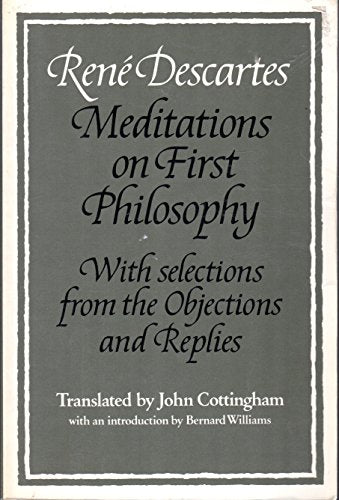
Rene Descartes: Meditations on First Philosophy by John Cottingham
Of all Descartes' works students are most often referred to his Meditations, as a key text in Western philosophy. This textbook extracts from the recently published two volume Philosophical Writings of Descartes (translated by Cottingham, Stoothoff and Murdoch) the authoritative, new translation of the Meditations and complements it with a thematic abridgement of the Objections and Replies. The selection of extracts from the Objections and Replies has been done specially for the present volume, with the aim of assisting the student to come to terms with the subtle reasoning of the Meditations by focusing on some of the principal philosophical difficulties raised by the work. Material is arranged thematically so as to indicate the main points of criticism which occured to Descartes' contemporaries as they read the Meditations, and how Descartes clarified his arguments in response to those criticisms. The new translation of these fundamental writings is based on the best available Latin or French texts, and rendered into clear, readable English.
RENE DESCARTES was born into a family of some means in the small French town of La Haye on March 31, 1596. With the death of his mother when Descartes was barely one year old, he was raised by grandparents until the age of ten when he entered the Jesuit school at La Fleche. At eighteen, Descartes enrolled in the University of Poitiers, where he earned a degree in law. Not long thereafter, while Descartes was serving in the military in the Netherlands he became acquainted with a mathematician and physicist by the name of Isaac Beeckman, who sparked his intellectual interest. A family legacy permitted Descartes to pursue these interests in relative comfort. From 1619 to 1628, Descartes lived in Paris, but spent a good bit of time traveling throughout Europe. It was during this time that he focused his attention on formulating a rational method that could free scientific think-ing and philosophical discourse from the rampant skepticism that threatened to drown discussion of important metaphysical and epistemological questions in a sea of uncertainty. Descartes developed a method that he believed could serve the needs of science and philosophy equally well. His efforts to realize this goal have earned him the title of the father of modern philosophy. In 1628, his travels ended, Descartes settled in the Netherlands, where he remained for the next twenty years. The last few months of his life were spent in Sweden, where he ventured in 1649 at the request of Queen Christina to instruct her in philosophy and to assist in the development of an institute for the advancement of science. While in Stockholm, Descartes came to the aid of the French ambassador, a friend who was suffering from pneumonia. Not long thereafter, Descartes contracted the disease and died on February 11, 1650. Rene Descartes's works include: The World (1633), Essais (1637), Discourse on Method (1637), Meditations Concerning Primary Philosophy (1644), Treatise on the Passions (1648), and Rules for the Direction of the Mind (published posthumously in 1701).
| SKU | Nicht verfügbar |
| ISBN 13 | 9780521338578 |
| ISBN 10 | 0521338573 |
| Titel | Rene Descartes: Meditations on First Philosophy |
| Autor | John Cottingham |
| Buchzustand | Nicht verfügbar |
| Bindungsart | Paperback |
| Verlag | Cambridge University Press |
| Erscheinungsjahr | 1986-10-09 |
| Seitenanzahl | 144 |
| Hinweis auf dem Einband | Die Abbildung des Buches dient nur Illustrationszwecken, die tatsächliche Bindung, das Cover und die Auflage können sich davon unterscheiden. |
| Hinweis | Nicht verfügbar |