


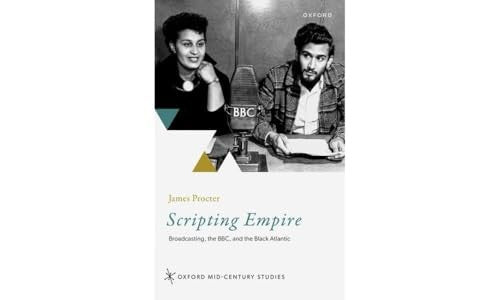
Scripting Empire by James Procter
Scripting Empire recovers the literary and cultural history of West Indian and West African writing at the BBC in order to rethink the critical mid-century decades of shrinking British sovereignty, late modernism, and mass migration to the metropole. Between the 1930s and the 1960s, a remarkable group of black Atlantic artists and intellectuals became producers, editors, and freelancers at the corporation, including Una Marson, Langston Hughes, Louise Bennett, Wole Soyinka, Derek Walcott, Amos Tutuola, V.S. Naipaul, Sam Selvon, Cyprian Ekwensi, Stuart Hall, and C.L.R. James. Operating at the interface of a range of literary and broadcast genres, this loose network of African Caribbean writers and thinkers prompt a reassessment of the aesthetic, formal, and political fallout of decolonization between the outbreak of World War II and the first airings of post-colonial independence. Scripting Empire works comparatively across dozens of different programmes spanning the General Overseas Service, Home Service, Light Programme, and Third Programme. Drawing upon a transnational archive of materials including scripts, correspondence, periodicals, visual records, and sound recordings, it seeks to re-position the cultural contribution of West Indians and West Africans within a more pervasive and porous account of radio transmission, the legacy of which extends well beyond broadcasting.
In the years of decolonization, an extraordinarily talented group of Caribbean women and men engaged in a daily refashioning of empire utilizing the channels of radioScripting Empire, beautifully written and based on a decade of original research, addresses questions of form, genre, and technology and gives us a different lens on the BBC and the Black Atlantic. * Catherine Hall, University College London *
James Procter's Scripting Empire is a perceptive and incisive exploration of a formative conjuncture in the story of mid-twentieth-century Black Atlantic modernism centered in London. Marked on one side by the centrality of broadcast radio to the infrastructures of literary production, circulation, and identity, and on the other, by the cultural-politics of decolonization, this is a conjuncture in which a generation of diasporic West Indian and West African writers navigated, challenged, appropriated, and transformed the BBC public sphere. Scripting Empire is a study of remarkable erudition. * David Scott, Columbia University *
James Procter's Scripting Empire is a perceptive and incisive exploration of a formative conjuncture in the story of mid-twentieth-century Black Atlantic modernism centered in London. Marked on one side by the centrality of broadcast radio to the infrastructures of literary production, circulation, and identity, and on the other, by the cultural-politics of decolonization, this is a conjuncture in which a generation of diasporic West Indian and West African writers navigated, challenged, appropriated, and transformed the BBC public sphere. Scripting Empire is a study of remarkable erudition. * David Scott, Columbia University *
James Procter is Professor of Modern and Contemporary Literature at Newcastle University. He is the author of Dwelling Places: Postwar Black British Writing (2003), Stuart Hall (2004), co-editor of Reading Across Worlds (2015), Out of Bounds: British Black and Asian Poets (2012), and Postcolonial Audiences: Readers, Viewers and Reception (2013), as well as numerous articles and chapters in leading postcolonial journals and book collections. His current research interests are in radio literature and empire between the 1930s and late 1960s, a project for which he was awarded a Leverhulme Research Fellowship in 2013-14.
| SKU | Nicht verfügbar |
| ISBN 13 | 9780198894179 |
| ISBN 10 | 0198894171 |
| Titel | Scripting Empire |
| Autor | James Procter |
| Serie | Oxford Mid-Century Studies Series |
| Buchzustand | Nicht verfügbar |
| Bindungsart | Hardback |
| Verlag | Oxford University Press |
| Erscheinungsjahr | 2024-03-18 |
| Seitenanzahl | 304 |
| Hinweis auf dem Einband | Die Abbildung des Buches dient nur Illustrationszwecken, die tatsächliche Bindung, das Cover und die Auflage können sich davon unterscheiden. |
| Hinweis | Nicht verfügbar |