
The Search for the Perfect Language


Zusammenfassung
The feel-good place to buy books
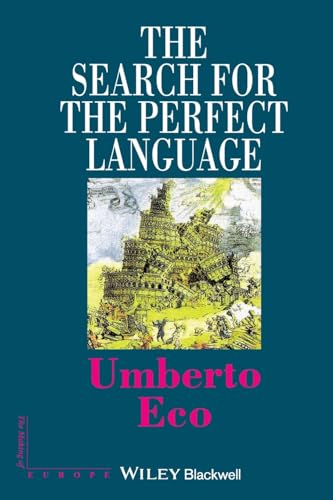
The Search for the Perfect Language by Umberto Eco
The idea that there once existed a language which perfectly and unambiguously expressed the essence of all possible things and concepts has occupied the minds of philosophers, theologians, mystics and others for at least two millennia. This is an investigation into the history of that idea and of its profound influence on European thought, culture and history. From the early Dark Ages to the Renaissance it was widely believed that the language spoken in the Garden of Eden was just such a language, and that all current languages were its decadent descendants from the catastrophe of the Fall and at Babel. The recovery of that language would, for theologians, express the nature of divinity, for cabbalists allow access to hidden knowledge and power, and for philosophers reveal the nature of truth. Versions of these ideas remained current in the Enlightenment, and have recently received fresh impetus in attempts to create a natural language for artificial intelligence. The story that Umberto Eco tells ranges widely from the writings of Augustine, Dante, Descartes and Rousseau, arcane treatises on cabbalism and magic, to the history of the study of language and its origins. He demonstrates the initimate relation between language and identity and describes, for example, how and why the Irish, English, Germans and Swedes - one of whom presented God talking in Swedish to Adam, who replied in Danish, while the serpent tempted Eve in French - have variously claimed their language as closest to the original. He also shows how the late eighteenth-century discovery of a proto-language (Indo-European) for the Aryan peoples was perverted to support notions of racial superiority. To this subtle exposition of a history of extraordinary complexity, Umberto Eco links the associated history of the manner in which the sounds of language and concepts have been written and symbolized. Lucidly and wittily written, the book is, in sum, a tour de force of scholarly detection and cultural interpretation, providing a series of original perspectives on two thousand years of European History. The paperback edition of this book is not available through Blackwell outside of North America.
"This is as much a history of the study of language and its origins as it is a tour de force pursuit using scholarly detection and cultural interpretation, thus providing a series of original perspectives on two thousand years of European history" The Medieval Review
Umberto Eco was born in Alessandria in 1932 and has been Professor of Semiotics at the University of Bologna since 1975 and the President of the International Center for Semiotic and Cognitive Studies at the Universityu of San Marino since 1988. His books include The Name of the Rose (1980), Foucault's Pendulum (1988) and the more recent works include Semiotics and Philosophy of Lanaguage (1984) and The Limits of Interpretation (1990).
| SKU | Nicht verfügbar |
| ISBN 13 | 9780631205104 |
| ISBN 10 | 0631205101 |
| Titel | The Search for the Perfect Language |
| Autor | Umberto Eco |
| Serie | Making Of Europe |
| Buchzustand | Nicht verfügbar |
| Bindungsart | Paperback |
| Verlag | John Wiley and Sons Ltd |
| Erscheinungsjahr | 1997-07-15 |
| Seitenanzahl | 400 |
| Hinweis auf dem Einband | Die Abbildung des Buches dient nur Illustrationszwecken, die tatsächliche Bindung, das Cover und die Auflage können sich davon unterscheiden. |
| Hinweis | Nicht verfügbar |