
Second Year Calculus


Zusammenfassung
The feel-good place to buy books
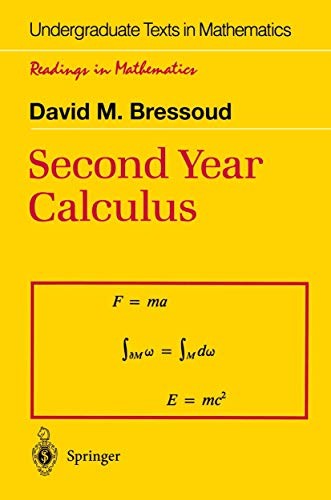
Second Year Calculus by David M Bressoud
Second Year Calculus: From Celestial Mechanics to Special Relativity covers multi-variable and vector calculus, emphasizing the historical physical problems which gave rise to the concepts of calculus. The book carries us from the birth of the mechanized view of the world in Isaac Newton's Mathematical Principles of Natural Philosophy in which mathematics becomes the ultimate tool for modelling physical reality, to the dawn of a radically new and often counter-intuitive age in Albert Einstein's Special Theory of Relativity in which it is the mathematical model which suggests new aspects of that reality. The development of this process is discussed from the modern viewpoint of differential forms. Using this concept, the student learns to compute orbits and rocket trajectories, model flows and force fields, and derive the laws of electricity and magnetism. These exercises and observations of mathematical symmetry enable the student to better understand the interaction of physics and mathematics.
The subtitle of this book, ``From celestial mechanics to special relativity'' is correctly indicative of its content, and in the preface, the author enthusiastically pleads guilty to blurring the line between mathematics and physicsOne of the book's merits is the substantive historical material given. Among other purposes this serves to show the physics setting in which many calculus concepts have their origin. The book eventually gets around to a fairly honest mathematical treatment of the traditional material of advanced calculus via differential forms, but before arriving at this in Chapter 5, mathematics students are likely to have some frustrating experiences. In Chapter 4 one encounters ``we define $\int\sp{bar b}\sb{bar a}f\sb 1(x,y,z)dx+f\sb 2(x,y,z)dy+f\sb 3(x,y,z)dz$ to be the work done by this force field as it moves a particle along the directed line segment from $bar a$ to $bar b$''. Exercise 8 at the end of this section states ``Prove that in an arbitrary force field the amount of work done in moving from $bar a$ to $bar b$ may be dependent on the path''. So, one asks oneself, how is {\it work} defined? Nothing more is to be found than the statement in Chapter 2 that work is force times distance, and the resulting representation as a dot product of vectors. The book has much to recommend it. If the first four chapters are primarily to serve as providing some intuitive foundation, it might be better to more explicitly acknowledge this, and to find a more appropriate formulation for whatever is intended in exercises such as the one cited above. ZENTRALBLATT MATH
Bressoud, David M.: - David Bressoud is DeWitt Wallace Professor of Mathematics at Macalester College, Minnesota. He is Chair of the MAA Committee on the Undergraduate Program in Mathematics and Chair-Elect of the MAA Special Interest Group on Teaching Advanced High School Mathematics.
| SKU | Nicht verfügbar |
| ISBN 13 | 9780387976068 |
| ISBN 10 | 038797606X |
| Titel | Second Year Calculus |
| Autor | David M Bressoud |
| Serie | Undergraduate Texts In Mathematics |
| Buchzustand | Nicht verfügbar |
| Bindungsart | Paperback |
| Verlag | Springer-Verlag New York Inc. |
| Erscheinungsjahr | 2001-03-30 |
| Seitenanzahl | 404 |
| Hinweis auf dem Einband | Die Abbildung des Buches dient nur Illustrationszwecken, die tatsächliche Bindung, das Cover und die Auflage können sich davon unterscheiden. |
| Hinweis | Nicht verfügbar |