
The Self and Its Brain


Zusammenfassung
The feel-good place to buy books
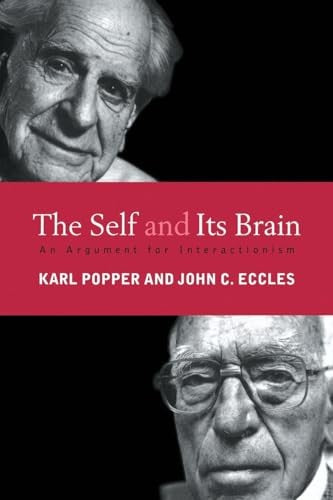
The Self and Its Brain by Karl Popper
The relation between body and mind is one of the oldest riddles that has puzzled mankind. That material and mental events may interact is accepted even by the law: our mental capacity to concentrate on the task can be seriously reduced by drugs. Physical and chemical processes may act upon the mind; and when we are writing a difficult letter, our mind acts upon our body and, through a chain of physical events, upon the mind of the recipient of the letter. This is what the authors of this book call the 'interaction of mental and physical events'. We know very little about this interaction; and according to recent philosophical fashions this is explained by the alleged fact that we have brains but no thoughts. The authors of this book stress that they cannot solve the body mind problem; but they hope that they have been able to shed new light on it. Eccles especially with his theory that the brain is a detector and amplifier; a theory that has given rise to important new developments, including new and exciting experiments; and Popper with his highly controversial theory of 'World 3'. They show that certain fashionable solutions which have been offered fail to understand the seriousness of the problems of the emergence of life, or consciousness and of the creativity of our minds. In Part I, Popper discusses the philosophical issue between dualist or even pluralist interaction on the one side, and materialism and parallelism on the other. There is also a historical review of these issues. In Part II, Eccles examines the mind from the neurological standpoint: the structure of the brain and its functional performance under normal as well as abnormal circumstances. The result is a radical and intriguing hypothesis on the interaction between mental events and detailed neurological occurrences in the cerebral cortex. Part III, based on twelve recorded conversations, reflects the exciting exchange between the authors as they attempt to come to terms with their opinions.'Anyone with an interest in philosophy, science and the future of the world should read it' - British Journal of Psychiatry
'A massive achievement ... a theory of beautiful simplicity, with all the relevant data clearly set out down to recent research findings.' - The Jerusalem Post
Sir Karl Popper was one of the foremost philosophers of the Twentieth century. Born in Vienna in 1902, Popper grew up in a city witnessing great intellectual ferment. His relationship with the philosophers and scientists led to his first book, The Logic of Scientific Discovery, published in 1934. On its publication in English in 1959 it was described by The New Scientist as 'one of the most important documents of the twentieth century'. On the eve of World War Two Popper was forced to flee to New Zealand, where he took up a teaching post at Canterbury University College at Christchurch. It was there, reflecting on the tyranny sweeping through Eastern Europe, that he wrote The Open Society and Its Enemies, published in 1945. In 1946 Popper moved to the London School of Economics, where he taught until his retirement in 1969. This period saw the publication of The Poverty of Historicism, described by the Sunday Times as 'probably the only book which will outlive this century'. He was knighted in 1965 and appointed Companion of Honour in 1982. He died in 1994.
| SKU | Nicht verfügbar |
| ISBN 13 | 9780415058988 |
| ISBN 10 | 0415058988 |
| Titel | The Self and Its Brain |
| Autor | Karl Popper |
| Buchzustand | Nicht verfügbar |
| Bindungsart | Paperback |
| Verlag | Taylor & Francis Ltd |
| Erscheinungsjahr | 1984-03-31 |
| Seitenanzahl | 616 |
| Hinweis auf dem Einband | Die Abbildung des Buches dient nur Illustrationszwecken, die tatsächliche Bindung, das Cover und die Auflage können sich davon unterscheiden. |
| Hinweis | Nicht verfügbar |