
The Shin Buddhist Classical Tradition


Zusammenfassung
The feel-good place to buy books
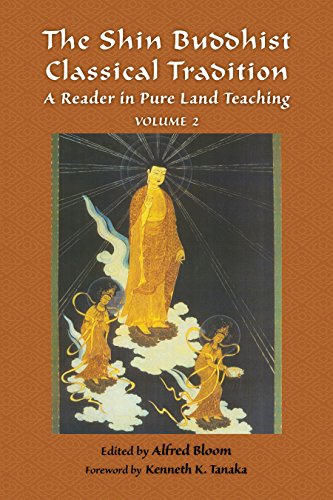
The Shin Buddhist Classical Tradition by Alfred Bloom
This second volume of passages gathered from the leading monks and teachers of the Pure Land, or Shin, school of Buddhist teaching focuses on religious practice. Extending from the foundational texts and first interpreters in the 4th century, to Rennyo in the 15th century, Professor Bloom's selections trace the development of Shin Buddhist teaching from monastic visualization practices to the widely popular path to salvation through faith in, and recitation of, the name of Amida Buddha. Volume 2 features a foreword by Kenneth K. Tanaka and an introduction by renowned scholar and editor, Alfred Bloom, whose selected passages have been arranged topically for easy reference on issues of Pure Land teaching. The key interpreters featured are the Seven Great Teachers from India, China, and Japan (Nagarjuna, Vasubandhu; T'an-luan, Tao-ch'o, Shan-tao; Genshin, Honen), selected as doctrinal authorities by Shinran (1173-1263), the founder of the Japanese Pure Land sect.
Alfred Bloom's new anthology brings together a wide range of excerpts from sutras, commentaries, sermons, essays, letters, poetry, and other sourcesMany of these materials have hitherto not been readily available in English translation. The volume's thematic arrangement recommends it to both scholars and general readers. It will be welcomed by those interested in Shinran's intellectual antecedents as well as the broader East Asian tradition of Pure Land Buddhism. -- Jacqueline Stone, Princeton University, author of Original Enlightenment and the Transformation of Medieval Japanese Buddhism Professor Alfred Bloom has spent a full and productive career making the ideas and values of Shin Buddhism accessible to English readers. In this momentous undertaking, he brings together his lifetime of insights into the tradition by gathering and organizing passages from the complete range of Pure Land teachings. Like Shinran's Kyogyoshinsho, Bloom's selections serve as a handbook for personal study and engagement with the tradition. Keeping his own commentary to a minimum, Bloom leaves it to his readers to discover the spiritual riches for themselves. -- Thomas P. Kasulis, Ohio State University The Shin Buddhist Classical Tradition symbolizes Dr. Bloom's deep personal wish for this branch of Buddhism to be made known to as wide an audience as possible. The vital passages of the tradition are categorized along topics that make the teachings more accessible to a contemporary audience regardless of their previous knowledge of Pure Land Buddhism -- Kenneth K. Tanaka, Musashino University, author of The Dawn of Chinese Pure Land Buddhist Doctrine
Alfred Bloom is one of the foremost authorities on Shin Buddhism. He received his PhD. from Harvard, and he is former professor at the University of Hawaii and Dean of the Institute of Buddhist Studies in Berkeley, California. He is the editor of The Essential Shinran and The Shin Buddhist Classical Tradition: A Reader in Pure Land Teaching, Vol. 1. He lives in Kailua, HI.
| SKU | Nicht verfügbar |
| ISBN 13 | 9781936597383 |
| ISBN 10 | 1936597381 |
| Titel | The Shin Buddhist Classical Tradition |
| Autor | Alfred Bloom |
| Buchzustand | Nicht verfügbar |
| Bindungsart | Paperback |
| Verlag | World Wisdom Books |
| Erscheinungsjahr | 2014-10-01 |
| Seitenanzahl | 208 |
| Hinweis auf dem Einband | Die Abbildung des Buches dient nur Illustrationszwecken, die tatsächliche Bindung, das Cover und die Auflage können sich davon unterscheiden. |
| Hinweis | Nicht verfügbar |