


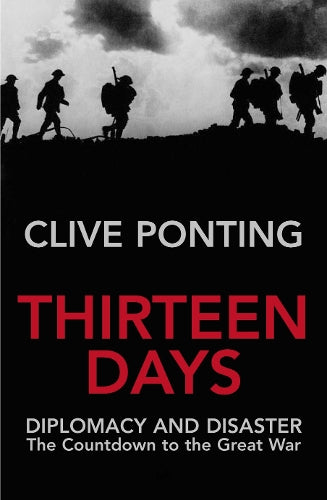
Thirteen Days by Clive Ponting
At the end of WWI, Germany was demonised. The Treaty of Versailles contained a 'war guilt' clause pinning the blame on the aggression of Germany and accusing her of 'supreme offence against international morality'. Thirteen Days rejects this verdict. Clive Ponting has made a thorough study of the incredibly complex diplomatic documents. His interpretation also rejects the thesis that Europe in 1914 had reached such a boiling point that war was bound to erupt and the theory that the origins of the War lay in a mighty arms race. He argues that the War occurred primarily because of the situation in the Balkans, while he gives full weight to Austria-Hungary's desire to cripple Serbia instead of negotiating, and to Russia's militaristic programme of expansion. Clive Ponting begins with a dramatic recreation of the assassination in Sarajevo on 28 June. He then examines how things spiralled out of control during the weeks that led to war. The tension builds as his story criss-crosses the capital cities of Europe and describes developments day by day, and, latterly, hour by hour. The First World War destroyed the old Europe. During four years of fighting nearly nine million soldiers were killed and twenty-one million wounded; over ten million civilians died. By the end of the War, three great European empires - Germany, Austria-Hungary and Russia - had disintegrated. Why did the War happen? In 1914, the states of Europe had been at peace for forty years, and every diplomatic dispute had been resolved peacefully. Thirteen Days describes failures of communication, fateful decisions and escalating military moves; it is an extraordinary narrative of personalities and diplomacy in the dying weeks of an era in which telephone networks were in their infancy and governments relied on telegrams in code and face-to-face meetings of ambassadors.
It is a hugely difficult feat of juggling, but Ponting somehow manages to keep all the balls in the airHis methodical approach and lively style result in a very clear account of an otherwise confusing period of frenetic diplomacy * Scotland on Sunday *
Compelling revisionist history * Sunday Tribune *
[A] fascinating picture of double-dealing, misread signals of intent and naked self-interest which afflicted every major capital over a crucial period * Glasgow Herald *
Compelling revisionist history * Sunday Tribune *
[A] fascinating picture of double-dealing, misread signals of intent and naked self-interest which afflicted every major capital over a crucial period * Glasgow Herald *
Clive Ponting was a Reader in Politics at the University of Wales, Swansea and is a specialist in environmental politics, political and military history. He has written numerous books including the world-wide bestseller A Green History of the World; a highly controversial revisionist biography of Winston Churchill; Armageddon: The Second World War; The Pimlico History of the Twentieth Century; World History: A New Perspective and The Crimean War: The Truth behind the Myth.
| SKU | Nicht verfügbar |
| ISBN 13 | 9780712668262 |
| ISBN 10 | 0712668268 |
| Titel | Thirteen Days |
| Autor | Clive Ponting |
| Buchzustand | Nicht verfügbar |
| Bindungsart | Paperback |
| Verlag | Vintage |
| Erscheinungsjahr | 2003-06-05 |
| Seitenanzahl | 384 |
| Hinweis auf dem Einband | Die Abbildung des Buches dient nur Illustrationszwecken, die tatsächliche Bindung, das Cover und die Auflage können sich davon unterscheiden. |
| Hinweis | Nicht verfügbar |