


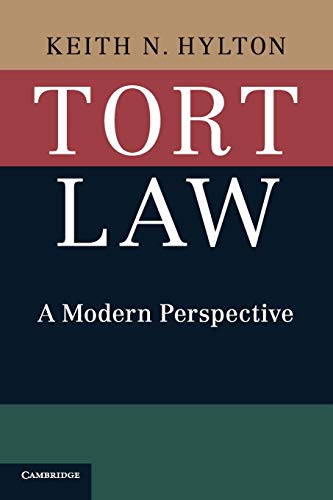
Tort Law by Keith N Hylton
Tort Law: A Modern Perspective is an advanced yet accessible introduction to tort law for lawyers, law students, and others. Reflecting the way tort law is taught today, it explains the cases and legal doctrines commonly found in casebooks using modern ideas about public policy, economics, and philosophy. With an emphasis on policy rationales, Tort Law encourages readers to think critically about the justifications for legal doctrines. Although the topic of torts is specific, the conceptual approach should pay dividends to those who are interested broadly in regulatory policy and the role of law. Incorporating three decades of advancements in tort scholarship, Tort Law is the textbook for modern torts classrooms.
Keith N. Hylton is William Fairfield Warren Distinguished Professor and a Professor of Law at Boston University specializing in tort law, antitrust law, intellectual property law, and labor law. His latest book, a utilitarian defense of the intellectual property laws, is Laws of Creation: Property Rights in the World of Ideas (2013).
| SKU | Nicht verfügbar |
| ISBN 13 | 9781107563421 |
| ISBN 10 | 1107563429 |
| Titel | Tort Law |
| Autor | Keith N Hylton |
| Buchzustand | Nicht verfügbar |
| Bindungsart | Paperback |
| Verlag | Cambridge University Press |
| Erscheinungsjahr | 2016-06-06 |
| Seitenanzahl | 460 |
| Hinweis auf dem Einband | Die Abbildung des Buches dient nur Illustrationszwecken, die tatsächliche Bindung, das Cover und die Auflage können sich davon unterscheiden. |
| Hinweis | Nicht verfügbar |