
The Violence of Britishness


Zusammenfassung
The feel-good place to buy books
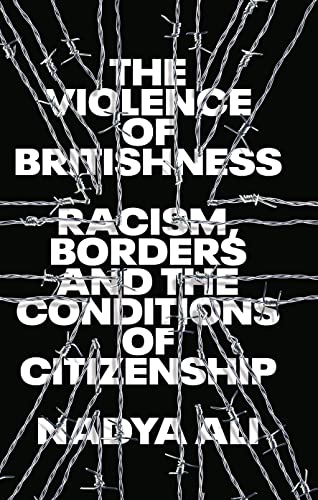
The Violence of Britishness by Nadya Ali
In post-Brexit Britain wracked by multiple crises, the entitlements of citizenship grow increasingly precarious. 'Britishness' is a way of understanding the nation shaped by white nationalism that acts as a powerful tool of racial bordering, separating the deserving from the undeserving. In The Violence of Britishness, Nadya Ali examines the impact of counter-terrorism and immigration policy on Muslims and other racially minoritised groups. Dissecting the Prevent strategy, she shows how Muslims have been compelled to reform their conduct and their faith in order to prove their 'Britishness', or risk being labelled an 'extremist' and made vulnerable to further state violence. Situating this within broader changes such as the hostile environment, austerity, and the cost of living crisis, who gets what is increasingly decided through who counts as sufficiently 'British'.'Nadya Ali’s book shows how the very idea of Britishness brings with it a racial hierarchy of belongingTracing the connections between various policy areas normally discussed in isolation – the hostile environment, Prevent, and citizenship deprivation – the book is a devastating account of how British life is shaped by colonialisms, old and new.'
-- Arun Kundnani, author of 'The Muslims are Coming!' (Verso Books, 2014)'A groundbreaking book detailing how counterterrorism and immigration policy intersect to pressure Muslims and communities of colour to change their behaviour or risk being labelled 'extremists’ and ‘terrorists’. The book not only contributes to awareness of the ideologies and mechanics of racialised state violence but will provide students, scholars, and communities with the tools to challenge and resist state violence in multiple ways. A must read.'
-- Dr. Rizwaan Sabir, Senior Lecturer in Criminology, Liverpool John Moores University and author of 'The Suspect' (Pluto Press, 2022)'How is it that in a society that eschews racism as a toxic remnant of the past, and that adopts explicitly non-racial policies, people of colour and Muslims especially are repeatedly rejected as belonging to Britain? In this sharp analysis of the intersection between counter terrorism and immigration, Nadya Ali shows how any answer must incorporate the structuring role of our colonial past.'
-- Alan Lester, Professor of Historical Geography, University of Sussex'In a moment when Britain seems to be in self-inflicted freefall, this work reminds us of the violence and cruelty involved in the demarcation of Britishness. Ali helps us to trace the connections between strands of state violence in order to persuade us that our only hope is an anti-racism that pushes back against all of these interlinked dehumanisations.'
-- Gargi Bhattacharyya, author of 'Dangerous Brown Men' and co-author of 'Empire's Endgame''An excellent contribution to our understanding of the politics around who counts as sufficiently 'British', revealing a sustained and steadily tightening constriction of Muslim communities.'
-- 'Renewal'| SKU | Nicht verfügbar |
| ISBN 13 | 9780745341705 |
| ISBN 10 | 0745341705 |
| Titel | The Violence of Britishness |
| Autor | Nadya Ali |
| Buchzustand | Nicht verfügbar |
| Bindungsart | Paperback |
| Verlag | Pluto Press |
| Erscheinungsjahr | 2023-05-20 |
| Seitenanzahl | 176 |
| Hinweis auf dem Einband | Die Abbildung des Buches dient nur Illustrationszwecken, die tatsächliche Bindung, das Cover und die Auflage können sich davon unterscheiden. |
| Hinweis | Nicht verfügbar |