
Visualization Techniques for Climate Change with Machine Learning and Artificial Intelligence


Proud to be B-Corp
The feel-good place to buy books
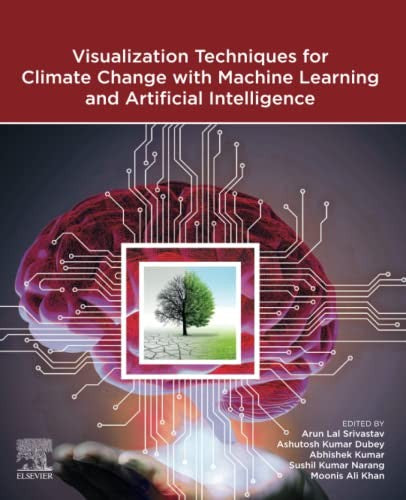
Visualization Techniques for Climate Change with Machine Learning and Artificial Intelligence by Ashutosh Kumar Dubey
Visualization Techniques for Climate Change with Machine Learning and Artificial Intelligence covers computer-aided artificial intelligence and machine learning technologies as related to the impacts of climate change and its potential to prevent/remediate the effects. As such, different types of algorithms, mathematical relations and software models may help us to understand our current reality, predict future weather events and create new products and services to minimize human impact, chances of improving and saving lives and creating a healthier world. This book covers different types of tools for the prediction of climate change and alternative systems which can reduce the levels of threats observed by climate change scientists. Moreover, the book will help to achieve at least one of 17 sustainable development goals i.e., climate action.
Ashutosh Kumar Dubey is an Associate Professor in the Department of Computer Science and Engineering at the Institute of Engineering and Technology of Chitkara University, India. He has more than 14 years of teaching experience. His research areas are Data Mining, Health Informatics, Optimization, Machine Learning, Cloud Computing, Artificial Intelligence and Object-Oriented Programming. Dr. Abhishek Kumar is a post-doctorate fellow in computer science at Ingenium Research Group, based at Universidad De Castilla-La Mancha in Spain. He has been teaching in academia for more than 8 years, and published more than 50 articles in reputed, peer reviewed national and international journals, books, and conferences. His research area includes artificial intelligence, image processing, computer vision, data mining, and machine learning. Sushil Kumar Narang is Dean and an Associate Professor in the Department of Computer Science & Engineering at Chitkara University, Rajpura, Punjab (India) since 2019. From 2006-2019, He was head of IT department at SAS Institute of IT & Research, Mohali, Punjab (India). From 1996-2006, He was Assistant Professor at Department of Computer Science & Applications, MLN College, Yamuna agar, Haryana (India).He has completed his Ph.D. at Panjab University, Chandigarh (India). His Research on “Feature Extraction and Neural Network Classifiers for Optical Character Recognition for Good quality hand written GurmukhiandDevnagariCharacters focused on various image processing, machine as well as deep learning algorithms. His research interests lie in the area of programming languages, ranging from theory to design to implementation, Image Processing, Data Analytics and Machine Learning. He has collaborated actively with researchers in several other disciplines of computer science; particularly Machine Learning on real world use cases.He is a certified Deep Learning Engineer from Edureka. ?He possesses expertise in Object-Oriented Analysis & Design and Development using Java and Python programming using OpenCV in Image Processing and Neural Network construction. ?He has strong knowledge of C++ and Java with experience in component architecture of product interface. With Solid training and management skills, He has demonstrated proficiency in leading and mentoring individuals to maximize levels of productivity, while forming cohesive team environments. Moonis Ali Khan received his doctoral degree (Ph.D.) in Applied Chemistry from Aligarh Muslim University, Aligarh, India, in 2009. From 2009 to 2011, he worked as a Post-Doctoral Researcher at Yonsei University, South Korea and Universiti Putra Malaysia, Malaysia. In 2011, he joined the Chemistry Department at the King Saud University (KSU), Saudi Arabia as an Assistant Professor. Currently, he is working as an Associate Professor at KSU. He is an interfacial chemist and his research is focused on the synthesis and development of novel materials for environmental remediation applications. To date, he has guided two doctoral students for their respective degrees. He has published more than hundred (research and review) articles and has two U.S. patents to his credit. Dr. Arun Lal Srivastav is working as an Associate Professor at Chitkara University, Himachal Pradesh in India. He is currently involved in the teaching of environmental science, environmental engineering, and disaster management to the undergraduate engineering students. His research interests include water treatment, river ecosystem, climate change, soil health maintenance, phytoremediation, and waste management. He has published around 91 research publication (as per SCOPUS) in various peer-reviewed, national and international journals, conferences, and books. He has also filed 25 patents on multidisciplinary topics. He is also working on four government-sponsored projects (worth ~16 million INR) on phytoremediation, adsorption, capacity building, organic farming, leachate treatment, agro-waste management, and so on.
| SKU | Nicht verfügbar |
| ISBN 13 | 9780323997140 |
| ISBN 10 | 0323997147 |
| Titel | Visualization Techniques for Climate Change with Machine Learning and Artificial Intelligence |
| Autor | Ashutosh Kumar Dubey |
| Buchzustand | Nicht verfügbar |
| Bindungsart | Paperback |
| Verlag | Elsevier - Health Sciences Division |
| Erscheinungsjahr | 2022-11-16 |
| Seitenanzahl | 498 |
| Hinweis auf dem Einband | Die Abbildung des Buches dient nur Illustrationszwecken, die tatsächliche Bindung, das Cover und die Auflage können sich davon unterscheiden. |
| Hinweis | Nicht verfügbar |