
The Age of Reason (1794)


The Age of Reason (1794)
Proud to be B-Corp
Our business meets the highest standards of verified social and environmental performance, public transparency and legal accountability to balance profit and purpose. In short, we care about people and the planet.
The feel-good place to buy books
- Free delivery in Australia
- Supporting authors with AuthorSHARE
- 100% recyclable packaging
- Proud to be a B Corp – A Business for good
- Buy-back with Ziffit
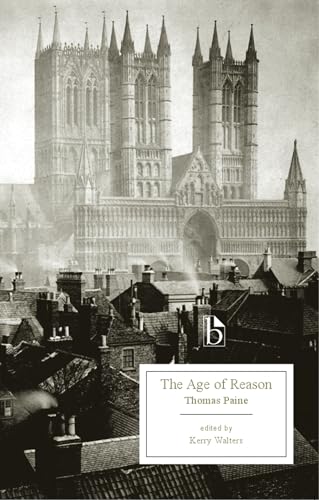
The Age of Reason (1794) by Thomas Paine
Thomas Paine who was a dynamic philosophical presence in the American Revolution of 1776 wrote his last book in 1795 on an investigation and commentary of organized religion with a focus on Christianity. Paine said that his religious duties included doing justice, loving benevolence, and attempting to make others happy. He called himself a deist which is a person who believes in the existence of a God based on the evidence of reason and nature but not on supernatural revelation. In this book he outlines deism as a rational religious belief and offers an analysis of the Bible based on textual content. He makes comparisons of the internal arguments of the Old and New Testaments by explaining, for example, inconsistencies of the biographic accounts in the four gospels. Paine suggests that since they were written separate of each other their basis is no better than hearsay. Because the United States convicted Paine of seditious libel in 1792, he escaped to France where he was selected to be a member of its National Convention. But there he conflicted with Robespierre, and while awaiting his arrest he wrote the first part of The Age of Reason. Afterwards he was confined in Luxembourg and wrote the second half of the book. The work was published in 1795 and serves as a criticism of established religion from the point of view of the 18th century deists. Paine's clear and concise understanding of the development of the Christian religion from its pagan origins is especially significant when the reader examines the interconnecting references and implications of superstition and fallacy that are still involved in any ceremonial aspect. And, finally, Thomas Paine explains the answer to any confrontation best of all: The most formidable weapon against errors of every kind is Reason.Thomas Paine who was a dynamic philosophical presence in the American Revolution of 1776 wrote his last book in 1795 on an investigation and commentary of organized religion with a focus on Christianity. Paine said that his religious duties included doing justice, loving benevolence, and attempting to make others happy. He called himself a deist which is a person who believes in the existence of a God based on the evidence of reason and nature but not on supernatural revelation. In this book he outlines deism as a rational religious belief and offers an analysis of the Bible based on textual content. He makes comparisons of the internal arguments of the Old and New Testaments by explaining, for example, inconsistencies of the biographic accounts in the four gospels. Paine suggests that since they were written separate of each other their basis is no better than hearsay. Because the United States convicted Paine of seditious libel in 1792, he escaped to France where he was selected to be a member of its National Convention. But there he conflicted with Robespierre, and while awaiting his arrest he wrote the first part of The Age of Reason. Afterwards he was confined in Luxembourg and wrote the second half of the book. The work was published in 1795 and serves as a criticism of established religion from the point of view of the 18th century deists. Paine's clear and concise understanding of the development of the Christian religion from its pagan origins is especially significant when the reader examines the interconnecting references and implications of superstition and fallacy that are still involved in any ceremonial aspect. And, finally, Thomas Paine explains the answer to any confrontation best of all: The most formidable weapon against errors of every kind is Reason.
Thomas Paine (1737-1809), a pamphleteer, revolutionary, radical, liberal, intellectual, and one of the Founding Fathers of the United States, was a pamphleteer, revolutionary, radical, liberal, intellectual, and one of the Founding Fathers of the United States. He went to America on Benjamin Franklin's recommendation, just in time to advocate the American Revolution with his strong and widely read tract, Common Sense. Later in life, he had a significant impact on the French Revolution. He wrote Rights of Man as a primer on Enlightenment ideals. In 1792, despite his incapacity to communicate in French, he was elected to the French National Assembly.
He was seen as a Girondist ally, but the Montagnards, particularly Robespierre, were growing dissatisfied with him. In December 1793, he was captured and imprisoned in Paris; he was released in 1794. His work The Age of Reason, which championed deism and criticized Christian ideas, made him famous. While in France, he also published Agrarian Justice, a pamphlet that analyzed the origins of property and proposed a proposal similar to a guaranteed minimum income.
He stayed in France until 1802, when he accepted an offer from Thomas Jefferson, the newly elected president of the United States.
| SKU | Unavailable |
| ISBN 13 | 9781554810451 |
| ISBN 10 | 1554810450 |
| Title | The Age of Reason (1794) |
| Author | Thomas Paine |
| Condition | Unavailable |
| Binding Type | Paperback |
| Publisher | Broadview Press Ltd |
| Year published | 2011-07-14 |
| Number of pages | 275 |
| Cover note | Book picture is for illustrative purposes only, actual binding, cover or edition may vary. |
| Note | Unavailable |