
Big Ideas


Big Ideas
Regular price
Checking stock...
Regular price
Checking stock...
Summary
.
The feel-good place to buy books
- Free delivery in Australia
- Supporting authors with AuthorSHARE
- 100% recyclable packaging
- Proud to be a B Corp – A Business for good
- Buy-back with Ziffit
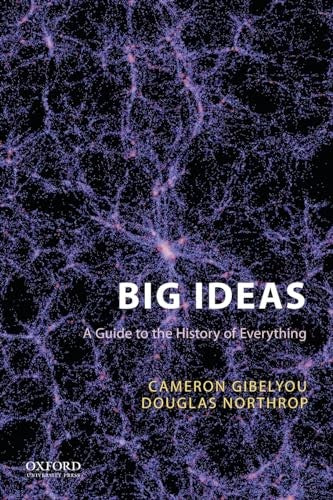
Big Ideas by Douglas Northrop
In Big Ideas: A Guide to the History of Everything, Cameron Gibelyou and Doug Northrop create a novel framework for thinking about the history and future of everything. Throughout the book, they grapple with issues at the intersection of the natural sciences, history, literature, philosophy, religion, and the humanities. In nine elegantly written chapters, Gibelyou and Northrup aim to make a reasoned analysis of worldviews that underlie historical writing across many fields. In the course of their broad and deep explorations they bring a wide range of voices to bear on fascinating questions of where everything--from the universe as a whole to any particular thing within it--came from, how it got to be the way it is today, and where things might be headed in the future. Big History invites readers to think about genuinely big questions carefully and rigorously, separating received narratives about the "history of everything" from the basic facts revealed by scientific and historical study. Their aim is to treat scientific explanation and humanistic interpretation as partners: inviting those with primarily scientific interests into a humanistic discussion about science and history, and encouraging those with core interests in the humanities into a discussion of how humanities-based ways of thinking might connect with and apply to the natural sciences. This engagement helps readers learn a basic narrative of the "history of everything" while constantly provoking thought about big questions and the field of Big History.
How do you write histories of all of time? How do you handle Time itself, or the moment of Creation? Or Evolution, or Causation and Contingency, or the spooky power of mathematical reasoning? And what is Entropy? In nine beautifully written chapters, Cameron Gibelyou and Douglas Northrop explore the perils and delights of writing, reading, and interpreting Big History* David Christian, author of Maps of Time: An Introduction to Big History *
Racing from the Big Bang to the present can make for a jarring ride, rocketing readers across enormous differences of evidence and idiom. But Northrop and Gibelyou positively delight in these disciplinary leaps. Rather than smoothing over the gaps, Big Ideas makes them integral to the story, exploring how each jump in scale plunges us into a new scholarly community with its own history and habits. In the process, the authors shed as much light on the evolution of the university as of the universe * and turn Big History into a lively forum for integrating cross-disciplinary knowledge. A game-changing contribution.Kären Wigen, Stanford University *
This is an important book that should be read by people in every discipline. It is a thoughtful and insightful examination about our ideas of how we originated, where we come from, how we got here, what our conditions mean now, and where we may be headed. Written by a historian and an astrophysicist, it integrates ideas about the sciences and the humanities and seeks the unity that universities should be seeking. From physics to philosophy and from chemistry to cultural studies, this book contributes significantly to our ideas about what it means to be an educated person in our time. * Lowell Gustafson, Villanova University *
In this important book, Cameron Gibelyou and Douglas Northrop offer a conversation among different ways or approaches to understanding the major ideas that we use or take for granted in everyday life and in scholarly fields. In both big and little ways, they examine knowledge from across different disciplines, answering questions and raising new ones. In each chapter, they invite readers to look behind the curtains and to join in the discussion. * Bob Bain, University of Michigan *
Big Ideas is essential reading for all who are interested in universal histories and will be absolutely invaluable to anyone teaching in the Big History field. It is a good choice for upper-division undergraduates and graduate students and could be seamlessly integrated into a general historiography course. Most important, this "Guide to the History of Everything" is a pathbreaking discussion on universal histories, about what we know and how we think about what we know. * David C. Fisher, World History Connected *
Racing from the Big Bang to the present can make for a jarring ride, rocketing readers across enormous differences of evidence and idiom. But Northrop and Gibelyou positively delight in these disciplinary leaps. Rather than smoothing over the gaps, Big Ideas makes them integral to the story, exploring how each jump in scale plunges us into a new scholarly community with its own history and habits. In the process, the authors shed as much light on the evolution of the university as of the universe * and turn Big History into a lively forum for integrating cross-disciplinary knowledge. A game-changing contribution.Kären Wigen, Stanford University *
This is an important book that should be read by people in every discipline. It is a thoughtful and insightful examination about our ideas of how we originated, where we come from, how we got here, what our conditions mean now, and where we may be headed. Written by a historian and an astrophysicist, it integrates ideas about the sciences and the humanities and seeks the unity that universities should be seeking. From physics to philosophy and from chemistry to cultural studies, this book contributes significantly to our ideas about what it means to be an educated person in our time. * Lowell Gustafson, Villanova University *
In this important book, Cameron Gibelyou and Douglas Northrop offer a conversation among different ways or approaches to understanding the major ideas that we use or take for granted in everyday life and in scholarly fields. In both big and little ways, they examine knowledge from across different disciplines, answering questions and raising new ones. In each chapter, they invite readers to look behind the curtains and to join in the discussion. * Bob Bain, University of Michigan *
Big Ideas is essential reading for all who are interested in universal histories and will be absolutely invaluable to anyone teaching in the Big History field. It is a good choice for upper-division undergraduates and graduate students and could be seamlessly integrated into a general historiography course. Most important, this "Guide to the History of Everything" is a pathbreaking discussion on universal histories, about what we know and how we think about what we know. * David C. Fisher, World History Connected *
Douglas Northrop
Douglas Northrop is an associate professor in the departments of history and Near Eastern studies at the University of Michigan. He is the author of Veiled Empire: Gender and Power in Stalinist Central Asia (Cornell University Press, 2004), which won both the W. Bruce Lincoln Prize and Heldt Prize. Northrop has also published articles in Slavic Review and Russian Review, to name a few. Northrop specializes in the modern history of Central Asia, but also focuses his writing and teaching on world history, environmental history, and the cultural aspects of modern colonialism.
Douglas Northrop is an associate professor in the departments of history and Near Eastern studies at the University of Michigan. He is the author of Veiled Empire: Gender and Power in Stalinist Central Asia (Cornell University Press, 2004), which won both the W. Bruce Lincoln Prize and Heldt Prize. Northrop has also published articles in Slavic Review and Russian Review, to name a few. Northrop specializes in the modern history of Central Asia, but also focuses his writing and teaching on world history, environmental history, and the cultural aspects of modern colonialism.
| SKU | Unavailable |
| ISBN 13 | 9780190201210 |
| ISBN 10 | 0190201215 |
| Title | Big Ideas |
| Author | Douglas Northrop |
| Condition | Unavailable |
| Binding Type | Paperback |
| Publisher | Oxford University Press Inc |
| Year published | 2020-09-22 |
| Number of pages | 464 |
| Cover note | Book picture is for illustrative purposes only, actual binding, cover or edition may vary. |
| Note | Unavailable |