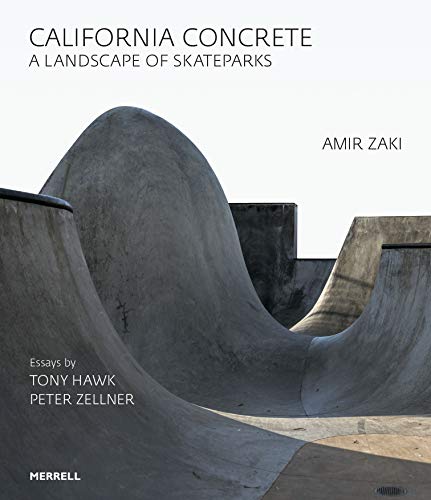
California Concrete by Amir Zaki

California Concrete by Amir Zaki

Regular price
Checking stock...
Regular price
Checking stock...
Summary

Southern California is the birthplace of skateboard culture. The artist Amir Zaki grew up skateboarding and so has a deep appreciation of the large concrete structures as sculptural forms, landscape, architecture and art. The importance of his photographs are underlined by Tony Hawk and Peter Zellner.

The feel-good place to buy books
  • Free delivery in Australia
  • Supporting authors with AuthorSHARE
  • 100% recyclable packaging
  • Proud to be a B Corp – A Business for good
  • Buy-back with Ziffit

California Concrete by Amir Zaki

Southern California is the birthplace of skateboard culture and, even though skateparks may be found worldwide today, it is where these parks continue to flourish as architects, engineers and skateboarders collaborate to refine their designs. The artist Amir Zaki grew up skateboarding, so he has an understanding of these spaces and, as someone who has spent years photographing the built and natural landscape of California, he has a deep appreciation of the large concrete structures not only as sculptural forms, but also as significant features of the contemporary landscape, belonging to a tradition of architecture and public art. To capture the images in this book, Zaki photographed in the early-morning light, climbing inside the bowls and pipes while there were no skaters around. Each photograph is a composite of dozens of shots taken with a digital camera mounted on a motorized tripod head. The resulting images are incredibly high resolution and can be printed at a large scale with no loss of detail. Their look is unusual in that Zaki's lens is somewhat telephoto, which has the effect of flattening space, yet the angle of view is often quite wide, which exaggerates spatial depth. The technology also allows Zaki to photograph certain areas from difficult positions that would otherwise be impossible to capture. Zaki makes the point that, by climbing deep inside these spaces, the visual experience is fundamentally different from viewing them from outside. In his text, Tony Hawk - one of world's best-known professional skateboarders - describes how Zaki's photographs of empty skateparks and open skies evoke memories of the idyllic freedom and the sense of potential that he felt when he first visited a skatepark as a child and saw skaters flying like birds in and out of the concrete pools and bowls. Hawk has skated in some of the parks featured in this book, and for him several of Zaki's images, taken from the skater's perspective, recall the experience of trying to learn a particular trick. A beautiful full pipe that looks like a barrelling wave may be, for Hawk and other seasoned skateboarders, a perfect example of function and form fitting together flawlessly in a well-designed skatepark. In his essay, the Los Angeles-based architect Peter Zellner offers a different perspective. Skateparks are made by excavating large open areas of land within city parks. The forms inside them may represent ocean waves, mountainous terrain and other features from nature, but they are permanently frozen in cement like Brutalist architecture. Every shape, line, transition, hip, tombstone, coping, stair, flow, tile, bowl, pipe, spine, rail, ledge, roll-in, kidney, clover, square and bank serves a specific purpose - to provide a challenging thrill and maximum pleasure for the rider. In this sense, skateparks epitomize function over form. In Zaki's mesmerizing photographs, however, these concrete landscapes suggest a more complex and integrated relationship with the history of design and architecture in Southern California.
Amir Zaki is an artist based in Southern California. He received a Master of Fine Arts degree from the University of California, Los Angeles in 1999, since which time he has regularly exhibited his photographs and videos both nationally and internationally, including in solo shows in Los Angeles, New York and Seattle. His work is held in numerous public and private collections across the United States, among them the Whitney Museum of American Art and the New Museum of Contemporary Art in New York, the Los Angeles County Museum of Art and the Santa Barbara Museum of Art. He has previously published two monographs, VLHV (2003) and Eleven Minus One (2010), featured in the anthologies of contemporary photography Vitamin Ph (2006), Photography is Magic (2015) and Both Sides of Sunset (2015), and contributed to the essays in Words Without Pictures (2010). Tony Hawk is an American professional skateboarder and the owner of the skateboard company Birdhouse. He was the National Skateboard Association's world champion for 12 consecutive years. One of the most influential pioneers of modern vertical skateboarding, in 1999 he became the first skater to land a '900' - a trick involving the completion of two-and-a-half mid-air revolutions on a skateboard. In 2002 he established the Tony Hawk Foundation, which helps to build skate parks in underprivileged areas. Peter Zellner is an architect based in Los Angeles. He has designed numerous notable public and private art galleries in Los Angeles and New York, and has curated exhibitions in New York, Los Angeles and Riverside, California. He is a faculty member at the School of Architecture of the University of Southern California in Los Angeles, and in 2016 he founded the Free School of Architecture, a non-profit organization committed to the free exploration and exchange of ideas in and around architecture. He is the author of several essays and books, including Pacific Edge (1998) and Hybrid Space (1999).
SKU Unavailable
ISBN 13 9781858946788
ISBN 10 1858946786
Title California Concrete
Author Amir Zaki
Condition Unavailable
Binding Type Hardback
Publisher Merrell Publishers Ltd
Year published 2019-09-01
Number of pages 128
Cover note Book picture is for illustrative purposes only, actual binding, cover or edition may vary.
Note Unavailable