


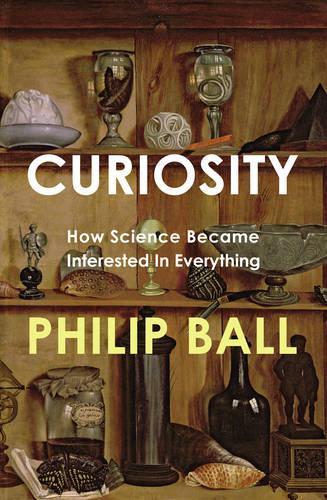
Curiosity by Philip Ball
There was a time when curiosity was condemned. To be curious was to delve into matters that didn't concern you - after all, the original sin stemmed from a desire for forbidden knowledge. Through curiosity our innocence was lost. Yet this hasn't deterred us. Today we spend vast sums trying to recreate the first instants of creation in particle accelerators, out of pure desire to know. There seems now to be no question too vast or too trivial to be ruled out of bounds: Why can fleas jump so high? What is gravity? What shape are clouds? Today curiosity is no longer reviled, but celebrated. Examining how our inquisitive impulse first became sanctioned, changing from a vice to a virtue, Curiosity begins with the age when modern science began, a time that spans the lives of Galileo and Isaac Newton. It reveals a complex story, in which the liberation – and the taming – of curiosity was linked to magic, religion, literature, travel, trade and empire. By examining the rise of curiosity, we can ask what has become of it today: how it functions in science, how it is spun and packaged and sold, how well it is being sustained and honoured, and how the changing shape of science influences the kinds of questions it may ask.
Philip Ball, like Levi, displays a polymath’s enthusiasm for knowledge of all kinds, and writes of science with humility and intelligent generosity -- Ian Thomson * Telegraph *
Ball’s fascinating book revels not just in the experiments of these early scientists, but also in their humanity, foibles and passions -- Ian Critchley * Sunday Times *
The overarching story here of how astrology gave way to chemistry and how magic gave way to science is a fascinating one -- Doug Johnstone * Scotland on Saturday *
This [is a] wonderfully nuanced and wise study of the scientific revolution -- Peter Forbes * Guardian *
Ball’s fascinating book revels not just in the experiments of these early scientists, but also in their humanity, foibles and passions -- Ian Critchley * Sunday Times *
The overarching story here of how astrology gave way to chemistry and how magic gave way to science is a fascinating one -- Doug Johnstone * Scotland on Saturday *
This [is a] wonderfully nuanced and wise study of the scientific revolution -- Peter Forbes * Guardian *
Philip Ball writes regularly in the scientific and popular media and worked for many years as an editor for physical sciences at Nature. His books cover a wide range of scientific and cultural phenomena, and include Critical Mass: How One Thing Leads To Another (winner of the 2005 Aventis Prize for Science Books), The Music Instinct, Curiosity: How Science Became Interested in Everything, Serving The Reich: The Struggle for the Soul of Science Under Hitler and Invisible: The history of the Unseen from Plato to Particle Physics.
| SKU | Unavailable |
| ISBN 13 | 9781847921727 |
| ISBN 10 | 1847921728 |
| Title | Curiosity |
| Author | Philip Ball |
| Condition | Unavailable |
| Binding Type | Hardback |
| Publisher | Vintage Publishing |
| Year published | 2012-05-17 |
| Number of pages | 480 |
| Cover note | Book picture is for illustrative purposes only, actual binding, cover or edition may vary. |
| Note | Unavailable |