


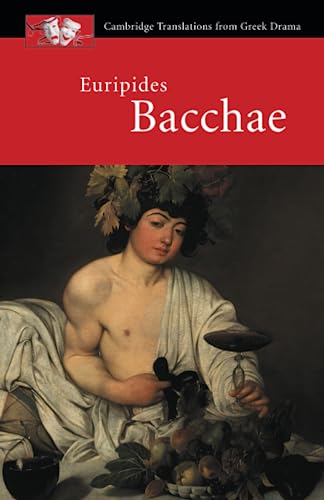
Euripides: Bacchae by Euripides
Treating ancient plays as living drama. Classical Greek drama is brought vividly to life in this series of new translations. Students are encouraged to engage with the text through detailed commentaries, including suggestions for discussion and analysis. In addition, numerous practical questions stimulate ideas on staging and encourage students to explore the play's dramatic qualities. Bacchae is suitable for students of both Classical Civilisation and Drama. Useful features include full synopsis of the play, commentary alongside translation for easy reference and a comprehensive introduction to the Greek Theatre. Bacchae is aimed primarily at A-level and undergraduate students in the UK, and college students in North America.
Euripides: - Euripides (484-406 BC) was a Greek dramatist. The last major tragic playwright of the classical world, he has also been called the first modern. Euripides was not highly successful in his lifetime, winning the first of only five victories at the Dionysia at the age of 43. By the end of the 19th century, however, Euripides was the most acclaimed Greek playwright. And, when the Royal Shakespeare Company presented a ten-play cycle The Greeks in 1980, seven of the works were by Euripides. Only 17 of his 92 plays survive. These include Medea, The Bacchae and Electra. Euripides's innovations included the deus ex machina and the formal prologue. He used simple everyday language, bringing a new realism to the stage. Although contemporaries accused him of killing tragedy, he humanized drama by adding elements of sentiment, romance, and even comedy. He was the first to argue against the social inferiority of women, and the first to show women in love. He was also the first to explore such subjects as madness and repression. A recluse, he shunned Athenian civil and social affairs, and in later life would sit all day in a cave on Salamis overlooking the sea as he contemplated and wrote something great and high. In 408 BC Euripides was exiled for his unorthodox views to Macedonia, where he died less than two years later. According to tradition, when the Spartans arrived to burn Athens, they desisted after a reminder that this was Euripides's city.
| SKU | Unavailable |
| ISBN 13 | 9780521653725 |
| ISBN 10 | 052165372X |
| Title | Euripides: Bacchae |
| Author | Euripides |
| Series | Cambridge Translations From Greek Drama |
| Condition | Unavailable |
| Binding Type | Paperback |
| Publisher | Cambridge University Press |
| Year published | 2000-07-20 |
| Number of pages | 114 |
| Cover note | Book picture is for illustrative purposes only, actual binding, cover or edition may vary. |
| Note | Unavailable |