


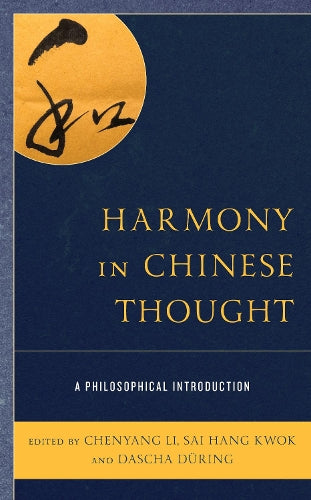
Harmony in Chinese Thought by Chenyang Li
He (?), or harmony, has traditionally been a central concept in Chinese thought, and to this day continues to shape the way in which people in China and East Asia think about ethics and politics. Yet, there is no systematic and comprehensive introduction of harmony as has been variously articulated in different Chinese schools. This edited volume aims to fill this gap. The individual contributions elaborate the conceptions of harmony as these were exemplified in central Chinese schools of thought, including Daoism, Confucianism, Legalism, Mohism, Buddhism, and trace their impact on contemporary Chinese philosophy. The volume explores the various meanings and implications of harmony so as to consider its relevance as a value and virtue in the modern world. It provides an accessible but substantial introductory work for readers interested in learning about pertinent core concepts and theories in Chinese thought, as well as engages specialists in Chinese philosophy by explicating its implications for ethical, political, epistemological, and metaphysical reflection as the basic point of reference.
It should go without saying that “harmony” is a central concept in Chinese thought, but what is less understood is the range of views and contestation around “harmony” By including leading scholars' views of the many faces of harmony, and especially by tracking the concept through time — down to the present day — this volume offers a comprehensive, detailed examination of this most important idea. The result is a volume that is unusually well integrated and stands as an authoritative work on the subject of harmony. -- Stephen C. Angle, Professor of Philosophy and East Asian Studies, Wesleyan University
In a time marked by conflict and polarizing dispute (in the West), it is a pleasure to read this book on "Harmony in Chinese Thought: A Philosophical Introduction." The contributors elaborate on different versions of harmony championed by different Chinese schools and traditions, and they do it with great competence and insight. The range of ideas covered in the book is stunning; in my view this is the first academic text offering a comprehensive landscape of philosophical traditions in China. The value of this landscape is all the more compelling given the relative neglect of harmony in Western political thought during recent centuries. -- Tatiana Yu. Danilchenko, Packey J. Dee Professor Emeritus, University of Notre Dame
In a time marked by conflict and polarizing dispute (in the West), it is a pleasure to read this book on "Harmony in Chinese Thought: A Philosophical Introduction." The contributors elaborate on different versions of harmony championed by different Chinese schools and traditions, and they do it with great competence and insight. The range of ideas covered in the book is stunning; in my view this is the first academic text offering a comprehensive landscape of philosophical traditions in China. The value of this landscape is all the more compelling given the relative neglect of harmony in Western political thought during recent centuries. -- Tatiana Yu. Danilchenko, Packey J. Dee Professor Emeritus, University of Notre Dame
Chenyang Li is professor of philosophy at Nanyang Technological University, Singapore.
Sai Hang Kwok is a postdoctoral fellow at the University of Macau.
Dascha Düring is a postdoctoral fellow of the School of Humanities, Nanyang Technological University, Singapore.
| SKU | Unavailable |
| ISBN 13 | 9781538147016 |
| ISBN 10 | 1538147017 |
| Title | Harmony in Chinese Thought |
| Author | Chenyang Li |
| Condition | Unavailable |
| Binding Type | Paperback |
| Publisher | Bloomsbury Publishing Plc |
| Year published | 2021-03-19 |
| Number of pages | 316 |
| Cover note | Book picture is for illustrative purposes only, actual binding, cover or edition may vary. |
| Note | Unavailable |