
How Psychologists Failed


How Psychologists Failed
Regular price
Checking stock...
Regular price
Checking stock...
Summary
Psychology has become a discipline with global influence, but continues to neglect the poor and minorities, and continues to adopt an incorrect model of science. This book explains what has gone wrong in psychology, and what steps need to be taken for psychology to become a constructive global force.
The feel-good place to buy books
- Free delivery in Australia
- Supporting authors with AuthorSHARE
- 100% recyclable packaging
- Proud to be a B Corp – A Business for good
- Buy-back with Ziffit
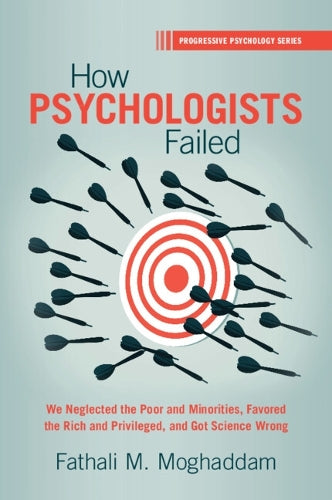
How Psychologists Failed by Fathali M Moghaddam
Psychology is a discipline with global influence, but continues to neglect disadvantaged minorities and continues to adopt an incorrect model of science. This volume explains what has gone wrong, and what steps should be taken for psychology to become a constructive international force. Historically, psychologists have focused only on causal explanations of behavior, neglecting normatively regulated behavior and intentionality. By giving greater importance to context and collective processes, moving from 'societies to cells,' psychologists can better understand and explain individual behavior. Poverty is an extremely powerful context that shapes cognitions and actions, with destructive consequences for disadvantaged individuals. The advocation of 'be happy psychology' and 'resilience' as solutions to problems faced by the disadvantaged leads to entrenched group-based inequalities, with the poor stuck at the bottom. Moving forwards, this volume proposes that psychologists should focus on normative systems to ultimately foster a more balanced field of study for the future.
'In this fascinating and provocative book, Moghaddam addresses two persistent biases in mainstream psychology: reductionism and determinismThese biases function systematically to conceal and misattribute collective disadvantage, Moghaddam compellingly argues. By centering collective processes and normative contexts, psychological science will discern and challenge poverty and injustice. A great read!' Winnifred Louis, University of Queensland, Australia
'This book is an intellectual feast from an intellectual force. In compelling detail, Moghaddam shows how the context of our lives affects the way we think, feel, and behave. Our health and happiness, the way we live and die, are determined by our surroundings. We ignore the conditions of our lives at our own peril. If we want to improve our lives, relationships, workplaces, and the world, we must stop believing in the meritocratic myth. Moghaddam tells us how to stop deluding ourselves and how to start promoting wellness, fairness, and worthiness. Compulsory reading, not just for psychologists, but for everyone concerned with our collective fate.' Isaac Prilleltensky, Author of How People Matter: Why it Affects Health, Happiness, Love, Work, and Society
'In this tour de force, Moghaddam exposes the limits of individualized psychology and illuminates how economic inequity and social class affect issues such as mental health, educational performance, and injustice. This eye-opening book should be required reading for psychology students and psychologists.' Michael Wessells, Columbia University, USA
'This book is an intellectual feast from an intellectual force. In compelling detail, Moghaddam shows how the context of our lives affects the way we think, feel, and behave. Our health and happiness, the way we live and die, are determined by our surroundings. We ignore the conditions of our lives at our own peril. If we want to improve our lives, relationships, workplaces, and the world, we must stop believing in the meritocratic myth. Moghaddam tells us how to stop deluding ourselves and how to start promoting wellness, fairness, and worthiness. Compulsory reading, not just for psychologists, but for everyone concerned with our collective fate.' Isaac Prilleltensky, Author of How People Matter: Why it Affects Health, Happiness, Love, Work, and Society
'In this tour de force, Moghaddam exposes the limits of individualized psychology and illuminates how economic inequity and social class affect issues such as mental health, educational performance, and injustice. This eye-opening book should be required reading for psychology students and psychologists.' Michael Wessells, Columbia University, USA
Fathali M. Moghaddam is Professor of Psychology at Georgetown University, where he served as Director of the Interdisciplinary Program in Cognitive Science (2016-2021). He also served as Editor-in-Chief of the APA journal Peace and Conflict: Journal of Peace Psychology (2014-2021). His extensive publications include about 30 books and 300 papers, and he has won a number of prestigious academic awards.
| SKU | Unavailable |
| ISBN 13 | 9781009069915 |
| ISBN 10 | 1009069918 |
| Title | How Psychologists Failed |
| Author | Fathali M Moghaddam |
| Series | Progressive Psychology |
| Condition | Unavailable |
| Binding Type | Paperback |
| Publisher | Cambridge University Press |
| Year published | 2022-11-03 |
| Number of pages | 200 |
| Cover note | Book picture is for illustrative purposes only, actual binding, cover or edition may vary. |
| Note | Unavailable |