


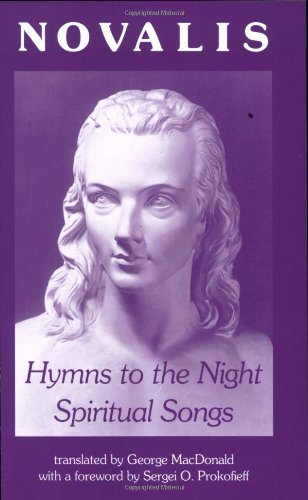
Hymns to the Night by Novalis
NOVALIS: HYMNS TO THE NIGHTA new edition of Novalis' Hymns To the Night, and Spiritual Songs, translated by George Macdonald, with an introduction and notes by Carol Appleby.
Includes the German text.Novalis (Friedrich von Hardenberg, 1772-1801) is the most mystical of the German Romantic poets. He is at once the most typical and the most unusual of the German Romantic writers, indeed, of all Romantic poets. His best known work, Hymns To the Night, was published in 1800.
Novalis is supremely idealistic, far more so than Johann Wolfgang von Goethe or Heinrich Heine. He died young, which makes him, like Percy Shelley and John Keats, something of a hero (or martyr). He did not write as much as Shelley, but his work, like that of Keats or Arthur Rimbaud, promised much. For Michael Hamburger, Novalis' work is almost totally idealistic:
Novalis's philosophy, then, is not mystical, but utopian. That is why his imaginative works are almost wholly lacking in conflict. They are a perpetual idyll.
It's true, Novalis' work is supremely idealistic, and utopian. But it is also mystical, because it points towards the invisible, unseen and unknown, and aims to reach that ecstatic realm (Novalis is the most obviously mystical of the German Romantic poets, but Holderlin, Goethe and Heine are no less mystical). Novalis wrote:
The sense of poetry has much in common with that for mysticism. It is the sense of the peculiar, personal, unknown, mysterious, for what is to be revealed, the necessary-accidental. It represents the unrepresentable. It sees the invisible, feels the unfeelable, etc... The sense for poetry has a close relationship with the sense for augury and the religious sense, with the sense for prophecy in general.
Glyn Hughes remarks of Novalis: 'The sustaining interest in the reading of Novalis's works is the sense of contact with a mind of visionary intensity and total commitment. The poetic achievement is in the momentary glimpses of ideal reality: what, in other contexts, we should call epiphanies. (61)
Novalis was born on Schloß Oberwiederstett in the year 1772 as Friedrich Freiherr von Hardenberg. Hardenberg is not hired into the state service after completing his legal studies, as expected, and begins a second education at the Bergakademie in Freiberg in 1797. In 1799, he starts working in the Salinenverwaltung in Weißenfels. His intense engagement with the philosophy and literature of his time, as well as his friendships with Schiller, Jean Paul, and Goethe, piques his interest in poetry and serves as the springboard for his literary-philosophical output. The first Fragments with the title Blüthenstaub appear in the Frühromantiker Friedrich and August Wilhelm Schlegel's Zeitschrift Athenaeum in 1798, under the name Novalis for the first time.
Novalis' increasing clout leads him to devote more time to religion: his most popular work is The Geistlichen Lieder, which was first published in the Musenalmanach in the year 1802. Heinrich von Ofterdingen, his unfinished Roman, is considered a key work in the field of early Romanticism. The attempt to compile an Enzyklopädie of all sciences and arts into a single body of knowledge fails miserably. The collection represents a pinnacle of earlyromantic synthesestreben in the realm of knowledge.
Novalis was born in the year 1801 in Weißenfels, near the Schwindsucht.
| SKU | Unavailable |
| ISBN 13 | 9780904693416 |
| ISBN 10 | 0904693414 |
| Title | Hymns to the Night |
| Author | Novalis |
| Condition | Unavailable |
| Binding Type | Paperback |
| Publisher | Temple Lodge Publishing |
| Year published | 2001-01-23 |
| Number of pages | 64 |
| Cover note | Book picture is for illustrative purposes only, actual binding, cover or edition may vary. |
| Note | Unavailable |