
Introduction to Statistical Modelling and Inference


Summary
The feel-good place to buy books
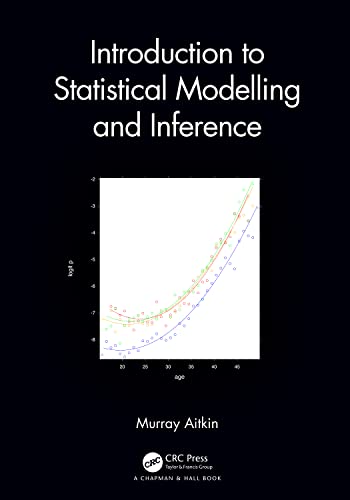
Introduction to Statistical Modelling and Inference by Murray Aitkin
The complexity of large-scale data sets (“Big Data”) has stimulated the development of advanced computational methods for analysing them. There are two different kinds of methods to aid this. The model-based method uses probability models and likelihood and Bayesian theory, while the model-free method does not require a probability model, likelihood or Bayesian theory. These two approaches are based on different philosophical principles of probability theory, espoused by the famous statisticians Ronald Fisher and Jerzy Neyman. Introduction to Statistical Modelling and Inference covers simple experimental and survey designs, and probability models up to and including generalised linear (regression) models and some extensions of these, including finite mixtures. A wide range of examples from different application fields are also discussed and analysed. No special software is used, beyond that needed for maximum likelihood analysis of generalised linear models. Students are expected to have a basic mathematical background in algebra, coordinate geometry and calculus. Features • Probability models are developed from the shape of the sample empirical cumulative distribution function (cdf) or a transformation of it. • Bounds for the value of the population cumulative distribution function are obtained from the Beta distribution at each point of the empirical cdf. • Bayes’s theorem is developed from the properties of the screening test for a rare condition. • The multinomial distribution provides an always-true model for any randomly sampled data. • The model-free bootstrap method for finding the precision of a sample estimate has a model-based parallel – the Bayesian bootstrap – based on the always-true multinomial distribution. • The Bayesian posterior distributions of model parameters can be obtained from the maximum likelihood analysis of the model. This book is aimed at students in a wide range of disciplines including Data Science. The book is based on the model-based theory, used widely by scientists in many fields, and compares it, in less detail, with the model-free theory, popular in computer science, machine learning and official survey analysis. The development of the model-based theory is accelerated by recent developments in Bayesian analysis.Murray Aitkin earned his BSc, PhD, and DSc from Sydney University in Mathematical Statistics. Dr Aitkin completed his post-doctoral work at the Psychometric Laboratory, University Of North Carolina, Chapel Hill. He has held Teaching/lecturing positions at Virginia Polytechnic Institute, the University of New South Wales, and Macquarie University along with research professor positions at Lancaster University (3 years, UK Social Science Research Council) and the University of Western Australia (5 years, Australian Research Council). He has been a Professor of Statistics at Lancaster University, Tel Aviv University and the University of Newcastle UK.
He has been a visiting researcher and also held consulting positions at the Educational Testing Service (Fulbright Senior Fellow 1971-2 and Senior Statistician 1988-89). He was the Chief Statistician 2000 – 2002 at the Education Statistics Services Institute, American Institutes for Research, Washington DC and advisor to the National Center for Education Statistics, US Department
of Education.
He is a Fellow of American Statistical Association; Elected Member at International Statistical Institute, and a Honorary member of Statistical Modelling Society.
He is a Honorary Professorial Associate at the University of Melbourne: Department of Psychology 2004 - 2008, Department (now School) of Mathematics and Statistics 2008 – current.
| SKU | Unavailable |
| ISBN 13 | 9781032105710 |
| ISBN 10 | 1032105712 |
| Title | Introduction to Statistical Modelling and Inference |
| Author | Murray Aitkin |
| Condition | Unavailable |
| Publisher | Taylor & Francis Ltd |
| Year published | 2022-09-30 |
| Number of pages | 374 |
| Cover note | Book picture is for illustrative purposes only, actual binding, cover or edition may vary. |
| Note | Unavailable |