
Kafka: Gender, Class, and Race in the Letters and Fictions


Summary
The feel-good place to buy books
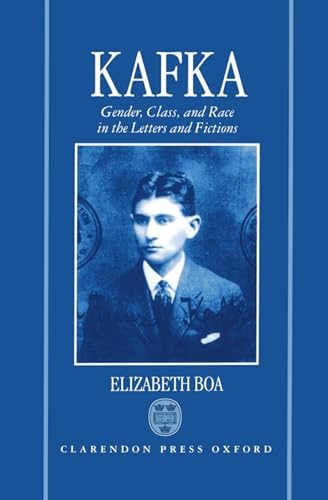
Kafka: Gender, Class, and Race in the Letters and Fictions by Elizabeth Boa
Elizabeth Boa's new study of Kafka centres on gender. It shows how, in an age of reactionary hysteria, Kafka rejected patriarchy yet exploited women as literary raw material. Drawing on Kafka's letters to his fiancee and to the Czech journalist, Milena Jesenska, Boa illuminates the transformation of details of everyday life into the strange yet uncannily familiar signs which are Kafka's stylistic hallmark. Kafka: Gender, Class, and Race in the Letters and Fictions argues that gender cannot be isolated from other dimensions of identity. The study relates Kafka's alienating images of the male body and fascinated disgust of female sexuality to the body-culture of the early twentieth century and to interfusing militaristic, racist, gender, and class ideologies. This is the context too for the stereotypes of the New Woman, the massive Matriarch, the lower-class seductress, and the assimilating Jew. The book explores Kafka's exploitation yet subversion of such stereotypes through the brilliant literary devices which assure his place in the modernist canon.
Boa certainly is very differentiated and admiringly clear in analyzing the intricate wyas in which gender, class, and race from complex conspiracies both in the fiction and in the letters of Franz Kafka* Elfriede Poder, Austrian History Yearbook, Vol.31, 2000. *
It is a book that Kafka scholars need to ponder. * Germanic Notes and Reviews *
a series of wide-ranging often perceptive readings of the letters and fiction ... This study consolidates and adds to recent research on Kafka's relation to his social and ideological circumstances ... The ambiguities in Kafka's construction of women are well brought out, and a detailed and generally persuasive case is made that gender plays a crucial role in the nexus of Kafka's themes and, indeed, in much of literary modernism. For these reasons, and also because critics will find much to take issue with in the wealth of detail with which Boa presents her case, the book is likely to become a focal study in Kafka criticism. * William J Dodd, MLR 95.1, 2000 *
To the author's credit, this implicitly political project is made overt without blunting literary critical sensibilities ... a sensitive treatment of an oft-neglected aspect of his work. * Richard Heinemann, Madison, Winsconsin, Modern Philology *
Elizabeth Boa's book is a stimulating and at times controversial account of gender, class and race in Kafka's letters and works of fiction * Forum for Modern Language Studies, vol 35, no 3, 1999 *
It is a book that Kafka scholars need to ponder. * Germanic Notes and Reviews *
a series of wide-ranging often perceptive readings of the letters and fiction ... This study consolidates and adds to recent research on Kafka's relation to his social and ideological circumstances ... The ambiguities in Kafka's construction of women are well brought out, and a detailed and generally persuasive case is made that gender plays a crucial role in the nexus of Kafka's themes and, indeed, in much of literary modernism. For these reasons, and also because critics will find much to take issue with in the wealth of detail with which Boa presents her case, the book is likely to become a focal study in Kafka criticism. * William J Dodd, MLR 95.1, 2000 *
To the author's credit, this implicitly political project is made overt without blunting literary critical sensibilities ... a sensitive treatment of an oft-neglected aspect of his work. * Richard Heinemann, Madison, Winsconsin, Modern Philology *
Elizabeth Boa's book is a stimulating and at times controversial account of gender, class and race in Kafka's letters and works of fiction * Forum for Modern Language Studies, vol 35, no 3, 1999 *
| SKU | Unavailable |
| ISBN 13 | 9780198158196 |
| ISBN 10 | 019815819X |
| Title | Kafka: Gender, Class, and Race in the Letters and Fictions |
| Author | Elizabeth Boa |
| Condition | Unavailable |
| Binding Type | Hardback |
| Publisher | Oxford University Press |
| Year published | 1996-06-27 |
| Number of pages | 320 |
| Cover note | Book picture is for illustrative purposes only, actual binding, cover or edition may vary. |
| Note | Unavailable |