


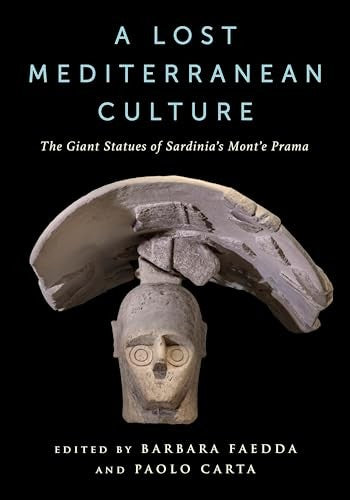
A Lost Mediterranean Culture by Barbara Faedda
This is the first English-language book to explore Monte Pramas limestone statuesamong the most important archaeological discoveries of the past fifty years and the source of fresh discoveries even today.
In recent decades, archaeological research in Sardinia has led to the extraordinary discovery of forty two-meter-tall statues of warriors with swords and shields, archers, and young people with gloved right handsThis impressive book tells the story of the discovery of these statues, adding greatly to our understanding of Sardinia's magnificent yet often forgotten ancient society. -- Michel Gras, Accademia Nazionale dei Lincei
This pioneering account of the 'Giants' of Mont'e Prama in English boosts the international community's knowledge of the early history of Sardinia, situated in the context of the ancient Mediterranean. Through discussing this outstanding series of full-size sculptures, referred to as the 'ancestors,' this book will help readers understand why Mont'e Prama has been proposed for inclusion in the UNESCO World Heritage List. -- Daniele F. Maras, Pontificia Accademia Romana di Archeologia, Rome
The extraordinary funerary area of Mont'e Prama, Sardinia, is characterized by many 'Giants,' limestone statues over two meters high aligned along the road, representing warriors, priests, and other culturally important figures. This book recounts the fascinating discovery and interpretation of the tombs and offers a significant new contribution to our knowledge of the necropolis. -- Giovanni Ugas, author of C’era una volta Atlantide. L’identità geografica e storica dell’isola di Platone
The volume succeeds in displaying Mont’e Prama and its giants as a unique and fascinating site embedded and rooted in the societies of the Nuragic Bronze and Iron Ages on Sardinia. * Antiquity *
This pioneering account of the 'Giants' of Mont'e Prama in English boosts the international community's knowledge of the early history of Sardinia, situated in the context of the ancient Mediterranean. Through discussing this outstanding series of full-size sculptures, referred to as the 'ancestors,' this book will help readers understand why Mont'e Prama has been proposed for inclusion in the UNESCO World Heritage List. -- Daniele F. Maras, Pontificia Accademia Romana di Archeologia, Rome
The extraordinary funerary area of Mont'e Prama, Sardinia, is characterized by many 'Giants,' limestone statues over two meters high aligned along the road, representing warriors, priests, and other culturally important figures. This book recounts the fascinating discovery and interpretation of the tombs and offers a significant new contribution to our knowledge of the necropolis. -- Giovanni Ugas, author of C’era una volta Atlantide. L’identità geografica e storica dell’isola di Platone
The volume succeeds in displaying Mont’e Prama and its giants as a unique and fascinating site embedded and rooted in the societies of the Nuragic Bronze and Iron Ages on Sardinia. * Antiquity *
Barbara Faedda serves at Columbia University as the executive director of the Italian Academy for Advanced Studies, where she conceived the International Observatory for Cultural Heritage, and as an adjunct professor in the Italian Department. In 2019, she was appointed ambassador, permanent observer for the European Public Law Organization to the United Nations. Her books include From Da Ponte to the Casa Italiana: A Brief History of Italian Studies at Columbia University (2017).
Paolo Carta is a professor at the University of Trento, where he teaches history of political thought and political theory and serves as dean of the School of Law. He has taught and lectured at the École Normale Supérieure, Columbia University, University of Oxford, Paris Sorbonne, and many other universities. His books include Lottare per il diritto (2020).
Contributors include Guido Clemente (University of Florence), Giuditta Giardini (Manhattan District Attorney’s Office), Marco Maiuro (Sapienza University of Rome), Roberto Nardi (Archaeological Conservation Center of Rome), Alfonso Stiglitz (Civic Museum of San Vero Milis), Emerenziana Usai (Superintendency of Archaeology, Fine Arts, and Landscape for the Metropolitan City of Cagliari and Provinces of Oristano and South Sardinia), Peter van Dommelen (Brown University), and Raimondo Zucca (University of Sassari).
Paolo Carta is a professor at the University of Trento, where he teaches history of political thought and political theory and serves as dean of the School of Law. He has taught and lectured at the École Normale Supérieure, Columbia University, University of Oxford, Paris Sorbonne, and many other universities. His books include Lottare per il diritto (2020).
Contributors include Guido Clemente (University of Florence), Giuditta Giardini (Manhattan District Attorney’s Office), Marco Maiuro (Sapienza University of Rome), Roberto Nardi (Archaeological Conservation Center of Rome), Alfonso Stiglitz (Civic Museum of San Vero Milis), Emerenziana Usai (Superintendency of Archaeology, Fine Arts, and Landscape for the Metropolitan City of Cagliari and Provinces of Oristano and South Sardinia), Peter van Dommelen (Brown University), and Raimondo Zucca (University of Sassari).
| SKU | Unavailable |
| ISBN 13 | 9780231212106 |
| ISBN 10 | 0231212100 |
| Title | A Lost Mediterranean Culture |
| Author | Barbara Faedda |
| Series | Columbiana |
| Condition | Unavailable |
| Binding Type | Hardback |
| Publisher | Columbia University Press |
| Year published | 2023-05-16 |
| Number of pages | 128 |
| Cover note | Book picture is for illustrative purposes only, actual binding, cover or edition may vary. |
| Note | Unavailable |