


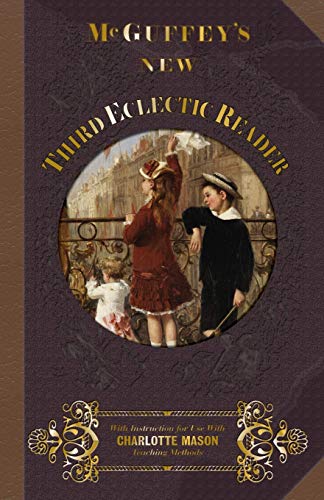
McGuffey's New Third Eclectic Reader by William Holmes Mcguffey
The third reader begins with lessons on articulation and marks and pauses (punctuation). The articulation lesson reviews some of the words from the last half of the second reader, while the punctuation instruction provides a brief overview of the basic punctuation marks and their uses. Each of these lessons includes a note to the teacher and the articulation lesson includes a model for class drill. These introductory lessons are followed by 86 language arts lessons, each based upon character-building stories, essays, and poetry. Each paragraph or stanza is numbered, which makes it easy to assign portions of a passage or poem as copywork, recitation, or narration. Additional short lessons and teacher notes are found throughout the text. In this reader, students will find spelling words listed at the beginning of each lesson. The first spelling and vocabulary lesson in the third reader contains words from the story that follows, including learn, richly, culling, harvest, cause, wintry, engage, livelong, youth, summer, leaving, and brightest. An effective way to use these readers is to use Charlotte Mason's language arts methods of copywork, recitation, and narration for any of the lessons presented. Instructions for each of these methods is found in the new 18-page introduction that has been added to this edition. Like Miss Mason, Mr. McGuffey believed in short lessons, learned well, so the Readers provide a convenient source for age-appropriate material to use with Miss Mason's methods.-
 McGuffey's New Second Eclectic Reader
-
 McGuffey's New First Eclectic Reader
-
 McGuffey's Eclectic Readers
-
 Revised Eclectic Readers
-
 McGuffey's First Eclectic Reader
-
 McGuffeys 7 Vol Set
-
 The New Mcguffey First Reader
-
 The New McGuffey Fourth Reader
-
 McGuffey's Fourth Eclectic Reader (Cram Edition)
-
 ... Mcguffey's First[-sixth] Eclectic Reader
-
 Mcguffey's Eclectic Reader
-
 McGuffey's Readers Sixth Eclectic Reader
-
 McGuffey's Readers Eclectic Spelling Book
-
 McGuffey's Readers First Eclectic Reader
-
 Mcguffey's New Sixth Eclectic Reader
-
 McGuffey's Readers Eclectic Primer
-
 McGuffey's Fifth Eclectic Reader


McGuffey, William Holmes: - William Holmes McGuffey (1800-1873) McGuffey was an American theologian and Professor of Moral Philosophy, Greek, and Latin who was described as rich in pungent phrase and anecdote, apt in citation from history, literature, and life, skillful in analogy (William Holmes McGuffey and his Readers, 145) He believed education should include spiritual and moral training, and was mindful of the practical and budgetary issues of teaching in the one-room schoolhouse on the frontier. His Readers were often the only books that children had access to, and according to an article in the History and Culture newsletter of the National Park Service (NPS), Most prominent post-Civil War and turn-of-the-century American figures credited their initial success in learning to the Readers. McGuffey's goal was to create a curriculum that even untrained teachers could use to provide practical instruction in communication skills through memorable stories and poems. The upper-level Readers introduce students to many classic works, though McGuffey did not see them as a replacement for full-length classic literature. He understood that many of his readers would not have access to a library, but wished to impart as rich an education as was possible with the limited time and resources available in nineteenth-century schools. He is credited with creating a generation of gifted orators and readers (NPS). Over a million copies of his books have been sold since they were first published, and they are still used in some schools and home schools.
| SKU | Unavailable |
| ISBN 13 | 9781613220177 |
| ISBN 10 | 1613220170 |
| Title | McGuffey's New Third Eclectic Reader |
| Author | William Holmes Mcguffey |
| Condition | Unavailable |
| Binding Type | Paperback |
| Publisher | Everyday Education, LLC |
| Year published | 2015-11-11 |
| Number of pages | 272 |
| Cover note | Book picture is for illustrative purposes only, actual binding, cover or edition may vary. |
| Note | Unavailable |