
Minorities and the Making of Postcolonial States in International Law


Minorities and the Making of Postcolonial States in International Law
Regular price
Checking stock...
Regular price
Checking stock...
Summary
The first comprehensive study of postcolonial statehood in international law from minority perspectives. Researchers from a wide range of disciplines will find this useful as a reference text and course reading. Policy-makers on humanitarian disasters, such as the ongoing Rohingya crisis, will also benefit from this multidisciplinary research.
The feel-good place to buy books
- Free delivery in Australia
- Supporting authors with AuthorSHARE
- 100% recyclable packaging
- Proud to be a B Corp – A Business for good
- Buy-back with Ziffit
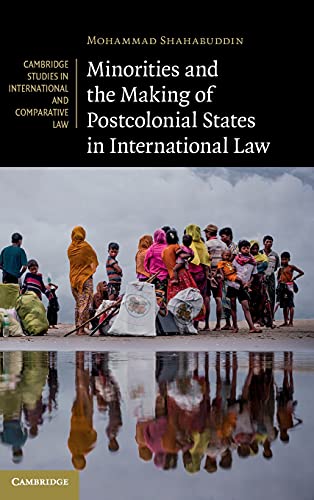
Minorities and the Making of Postcolonial States in International Law by Mohammad Shahabuddin
The ideological function of the postcolonial 'national', 'liberal', and 'developmental' state inflicts various forms of marginalisation on minorities, but simultaneously justifies oppression in the name of national unity, equality and non-discrimination, and economic development. International law plays a central role in the ideological making of the postcolonial state in relation to postcolonial boundaries, the liberal-individualist architecture of rights, and the neoliberal economic vision of development. In this process, international law subjugates minority interests and in turn aggravates the problem of ethno-nationalism. Analysing the geneses of ethno-nationalism in postcolonial states, Mohammad Shahabuddin substantiates these arguments with in-depth case studies on the Rohingya and the hill people of the Chittagong Hill Tracts, against the historical backdrop of the minority question in Indian nationalist and constitutional discourse. Shahabuddin also proposes alternative international law frameworks for minorities.
'Mohammad Shahabuddin has now written a timely, theoretically informed, and empirically grounded book on the subject of ethno-nationalism, postcolonial states, and international lawIt continues the pathbreaking work Shahabuddin began with his previous monograph Ethnicity and International Law (2016). His work deserves to be read by anyone interested in the fate of minorities and subaltern groups in postcolonial states.' B.S. Chimni, Foreword
'Minorities and the Making of Postcolonial States in International Law is a groundbreaking work. Shahabuddin skillfully marshals a variety of the most advanced critical methodologies of the past generation to produce an original perspective on some of the central conflicts of our time. His magisterial exposition makes crucial contributions to a number of fields: international law, post-colonialism, ethno-nationalism, state-formation, and global feminism, among others. Moreover, by demonstrating the urgency of bringing these fields together, this book should be indispensable reading for all future work on any of them. Shahabuddin's case studies - the Rohingya in Myanmar, the Chittagong Hill Tracts people in Bangladesh, and the broad problematics of Indian ethno-nationalism - compellingly reveal the life-and-death issues animating his important work.' Nathaniel Berman, Brown University
'Why are postcolonial states more vulnerable to ethnonationalism and the oppression of minorities? While international law's embedding of this problem in decolonization has been demonstrated in different ways, the point of departure is usually the vision of the state produced by international law. Mohammad Shahabuddin offers a fresh critical perspective by starting instead with nationalist ruling elites. Arguing that they approach the postcolonial state as an ideology of national past, liberal present and developmental future, he then richly shows how international law facilitates each of these elements and the interlocking forms of oppression that they serve to inflict on minorities.' Karen Knop, University of Toronto
'This is an outstanding book which combines archival work and history with theoretical innovation and insight to provide a fresh understanding of an enduring and tragic phenomenon, ethnic conflict. What makes this study distinctive and powerful is that its doctrinal analysis is illuminated by historical and sociological studies of nationalism. As a result, the particular case studies explored here have a far-reaching relevance. It is superbly written, and has a special quality of momentum that makes it very readable as the argument unfolds with evidence and research carefully integrated to further the broader movement.' Antony Anghie, University of Utah and National University of Singapore
'Minorities and the Making of Postcolonial States in International Law is a groundbreaking work. Shahabuddin skillfully marshals a variety of the most advanced critical methodologies of the past generation to produce an original perspective on some of the central conflicts of our time. His magisterial exposition makes crucial contributions to a number of fields: international law, post-colonialism, ethno-nationalism, state-formation, and global feminism, among others. Moreover, by demonstrating the urgency of bringing these fields together, this book should be indispensable reading for all future work on any of them. Shahabuddin's case studies - the Rohingya in Myanmar, the Chittagong Hill Tracts people in Bangladesh, and the broad problematics of Indian ethno-nationalism - compellingly reveal the life-and-death issues animating his important work.' Nathaniel Berman, Brown University
'Why are postcolonial states more vulnerable to ethnonationalism and the oppression of minorities? While international law's embedding of this problem in decolonization has been demonstrated in different ways, the point of departure is usually the vision of the state produced by international law. Mohammad Shahabuddin offers a fresh critical perspective by starting instead with nationalist ruling elites. Arguing that they approach the postcolonial state as an ideology of national past, liberal present and developmental future, he then richly shows how international law facilitates each of these elements and the interlocking forms of oppression that they serve to inflict on minorities.' Karen Knop, University of Toronto
'This is an outstanding book which combines archival work and history with theoretical innovation and insight to provide a fresh understanding of an enduring and tragic phenomenon, ethnic conflict. What makes this study distinctive and powerful is that its doctrinal analysis is illuminated by historical and sociological studies of nationalism. As a result, the particular case studies explored here have a far-reaching relevance. It is superbly written, and has a special quality of momentum that makes it very readable as the argument unfolds with evidence and research carefully integrated to further the broader movement.' Antony Anghie, University of Utah and National University of Singapore
Mohammad Shahabuddin is Professor of International Law and Human Rights at Birmingham Law School, University of Birmingham. He received a Leverhulme Trust Research Fellowship (2018–20) for completing this monograph. His previous book, Ethnicity and International Law (Cambridge, 2016), offered the first ever comprehensive analysis of how ethnicity shaped international law.
| SKU | Unavailable |
| ISBN 13 | 9781108483674 |
| ISBN 10 | 1108483674 |
| Title | Minorities and the Making of Postcolonial States in International Law |
| Author | Mohammad Shahabuddin |
| Series | Cambridge Studies In International And Comparative Law |
| Condition | Unavailable |
| Binding Type | Hardback |
| Publisher | Cambridge University Press |
| Year published | 2021-06-10 |
| Number of pages | 250 |
| Cover note | Book picture is for illustrative purposes only, actual binding, cover or edition may vary. |
| Note | Unavailable |