
Perjury and Pardon, Volume I


Perjury and Pardon, Volume I
Regular price
Checking stock...
Regular price
Checking stock...
Proud to be B-Corp
Our business meets the highest standards of verified social and environmental performance, public transparency and legal accountability to balance profit and purpose. In short, we care about people and the planet.
The feel-good place to buy books
- Free delivery in Australia
- Supporting authors with AuthorSHARE
- 100% recyclable packaging
- Proud to be a B Corp – A Business for good
- Buy-back with Ziffit
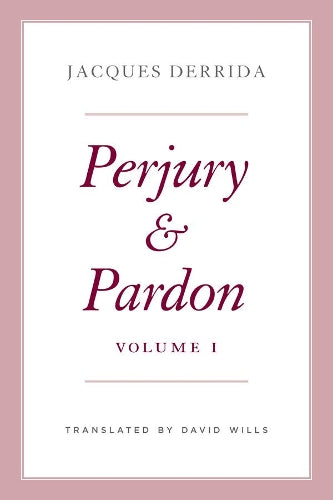
Perjury and Pardon, Volume I by Jacques Derrida
An inquiry into the problematic of perjury, or lying, and forgiveness from one of the most influential philosophers of the twentieth century. “One only ever asks forgiveness for what is unforgivable.” From this contradiction begins Perjury and Pardon, a two-year series of seminars given by Jacques Derrida at the École des hautes études en sciences sociales in Paris in the late 1990s. In these sessions, Derrida focuses on the philosophical, ethical, juridical, and political stakes of the concept of responsibility. His primary goal is to develop what he calls a “problematic of lying” by studying diverse forms of betrayal: infidelity, denial, false testimony, perjury, unkept promises, desecration, sacrilege, and blasphemy. Although forgiveness is a notion inherited from multiple traditions, the process of forgiveness eludes those traditions, disturbing the categories of knowledge, sense, history, and law that attempt to circumscribe it. Derrida insists on the unconditionality of forgiveness and shows how its complex temporality destabilizes all ideas of presence and even of subjecthood. For Derrida, forgiveness cannot be reduced to repentance, punishment, retribution, or salvation, and it is inseparable from, and haunted by, the notion of perjury. Through close readings of Kant, Kierkegaard, Shakespeare, Plato, Jankélévitch, Baudelaire, and Kafka, as well as biblical texts, Derrida explores diverse notions of the “evil” or malignancy of lying while developing a complex account of forgiveness across different traditions.
“For those readers who are familiar with Derrida’s most famous work and are curious about his deconstructive ethics and have not read any of the essays drawn from this book, this is a good place to approach the topic. . . Even if one has read one or more of the published portions, if one is unsure how they fit together, these lectures will allow one to see how they cohere. . . . The translation is superb and the editorial work is excellent.” * The Review of Metaphysics *
"While much has been written about Derrida’s discussions of forgiveness, much less has been said about his approach to perjury. . . . These two volumes are a valuable addition to the ongoing project of publishing Derrida's work in English. They will be especially valuable to scholars of ethics, general philosophy, and legal studies." * Choice *
"This volume is for strong humanities and philosophy collections." * Library Journal *
"In the two decades since Perjury and Pardon was written, the questions raised by Derrida’s prescient probing of the puzzling paradoxes of forgiveness have become even more urgent. During a time of unrepentant rage and specious pardons, what does it mean to forgive? Does anyone deserve forgiveness? Should the unforgivable be forgiven? Is it possible to live together without forgiveness? As we struggle to answer these critical questions, Derrida’s guiding insight is important today more than ever." -- Mark C. Taylor, Columbia University
"These rich stimulating lectures are classic Derrida and in David Wills's superb translation wonderfully accessible. This is a great example of Derrida the educator introducing his audience to some of the most difficult issues of our time." -- Robert Bernasconi, Penn State University
“Perjury and Pardon presents an expansive vision of responsibility with the supreme clarity and profound rigor that mark Derrida’s style as a formidable teacher across geographical and academic boundaries. Wills's unique interpretative skills have resulted in yet another unsurpassed translation of Derrida's breathtaking thought and legacy.” -- Hent de Vries, New York University
"While much has been written about Derrida’s discussions of forgiveness, much less has been said about his approach to perjury. . . . These two volumes are a valuable addition to the ongoing project of publishing Derrida's work in English. They will be especially valuable to scholars of ethics, general philosophy, and legal studies." * Choice *
"This volume is for strong humanities and philosophy collections." * Library Journal *
"In the two decades since Perjury and Pardon was written, the questions raised by Derrida’s prescient probing of the puzzling paradoxes of forgiveness have become even more urgent. During a time of unrepentant rage and specious pardons, what does it mean to forgive? Does anyone deserve forgiveness? Should the unforgivable be forgiven? Is it possible to live together without forgiveness? As we struggle to answer these critical questions, Derrida’s guiding insight is important today more than ever." -- Mark C. Taylor, Columbia University
"These rich stimulating lectures are classic Derrida and in David Wills's superb translation wonderfully accessible. This is a great example of Derrida the educator introducing his audience to some of the most difficult issues of our time." -- Robert Bernasconi, Penn State University
“Perjury and Pardon presents an expansive vision of responsibility with the supreme clarity and profound rigor that mark Derrida’s style as a formidable teacher across geographical and academic boundaries. Wills's unique interpretative skills have resulted in yet another unsurpassed translation of Derrida's breathtaking thought and legacy.” -- Hent de Vries, New York University
Jacques Derrida (1930–2004) was director of studies at the École des hautes études en sciences sociales, Paris, and professor of humanities at the University of California, Irvine. Several of his books have been published in their English translation by the University of Chicago Press. Ginette Michaud is professor emerita in the Département des littératures de langue française at the Université de Montréal. She has coedited several texts on Derrida. Nicholas Cotton is professor of French literature at Cégep Édouard-Montpetit. David Wills is a professor of French studies at Brown University and the translator of a number of works by Derrida.
| SKU | Unavailable |
| ISBN 13 | 9780226819174 |
| ISBN 10 | 0226819175 |
| Title | Perjury and Pardon, Volume I |
| Author | Jacques Derrida |
| Series | The Seminars Of Jacques Derrida |
| Condition | Unavailable |
| Binding Type | Hardback |
| Publisher | The University of Chicago Press |
| Year published | 2022-09-27 |
| Number of pages | 368 |
| Cover note | Book picture is for illustrative purposes only, actual binding, cover or edition may vary. |
| Note | Unavailable |