
Principles of Comparative Politics


Principles of Comparative Politics
Regular price
Checking stock...
Regular price
Checking stock...
Summary
This book offers the most comprehensive and up-to-date introduction to comparative inquiry, research, and scholarship. It also benefits from an international focus, taking into consideration nearly 200 countries.
The feel-good place to buy books
- Free delivery in Australia
- Supporting authors with AuthorSHARE
- 100% recyclable packaging
- Proud to be a B Corp – A Business for good
- Buy-back with Ziffit
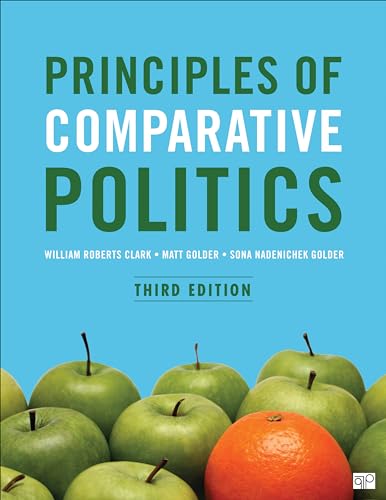
Principles of Comparative Politics by William Roberts Clark
Principles of Comparative Politics offers the most comprehensive and up-to-date introduction to comparative inquiry, research, and scholarship. In this thoroughly revised Third Edition, students now have an even better guide to cross-national comparison and why it matters. The new edition retains a focus on the enduring questions with which scholars grapple, the issues about which consensus has started to emerge, and the tools comparativists use to get at the complex problems in the field. Among other things, the updates to this edition include a thoroughly-revised chapter on dictatorships that incorporates a discussion of the two fundamental problems of authoritarian rule: authoritarian power-sharing and authoritarian control; a revised chapter on culture and democracy that includes a more extensive examination of cultural modernization theory and a new overview of survey methods for addressing sensitive topics; a new section on issues related to electoral integrity; an expanded assessment of different forms of representation; and a new intuitive take on statistical analyses that provides a clearer explanation of how to interpret regression results. Examples from the gender and politics literature have been incorporated into various chapters, the Problems sections at the end of each chapter have been expanded, a! nd the empirical examples and data on various types of institutions have been updated. Online videos and tutorials are available to address some of the more methodological components discussed in the book. The authors have thoughtfully streamlined chapters to better focus attention on key topics.
"Principles of Comparative Politics is a very comprehensive, rigorous, and detailed textIt is logically and effectively organized, across and within chapters. One of its strengths is the way the text discusses the strengths and weaknesses of different types of institutions and introduces students to debates in the literature. I will continue to assign the textbook so students are made to engage with the heated and continuing debates in political science." -- Tayna Bagashka
"It is both my opinion and a majority of students’ opinion that Principles of Comparative Politics clearly and concisely presents and describes theories and concepts. From my experience, the book is clearer than most of the alternatives focused on Comparative Politics. From the student’s experience, the book is clearer than many similar texts they have read in Political Science and other disciplines. I believe the book manages to cover many of the relevant themes in Comparative Politics within a logical and interesting framework; as part of a more relevant discussion of the differences in democracy and dictatorships." -- Nick Clark
"The key strength to Principles of Comparative Politics is the theoretical approach. This is the best undergraduate text I have found within both Comparative and International Relations for introducing the scientific method and recent research. I feel that students leave this textbook understanding what political science truly is and what differentiates this field from area specialists. In addition, the book also acts as a comprehensive primer to rational choice theory, and is a great text to be used as a supplement to a rational choice class if looking for a substantive example." -- Christine Mele
"After more than 20 years in the profession, Principles of Comparative Politics is truly the first textbook that will pave the way to establish norms on how to teach Introduction to Comparative Politics. Traditional method is outdated and too historical. This textbook provides an introduction to the ‘science of politics.’" -- Emizet Kisangani
"It is both my opinion and a majority of students’ opinion that Principles of Comparative Politics clearly and concisely presents and describes theories and concepts. From my experience, the book is clearer than most of the alternatives focused on Comparative Politics. From the student’s experience, the book is clearer than many similar texts they have read in Political Science and other disciplines. I believe the book manages to cover many of the relevant themes in Comparative Politics within a logical and interesting framework; as part of a more relevant discussion of the differences in democracy and dictatorships." -- Nick Clark
"The key strength to Principles of Comparative Politics is the theoretical approach. This is the best undergraduate text I have found within both Comparative and International Relations for introducing the scientific method and recent research. I feel that students leave this textbook understanding what political science truly is and what differentiates this field from area specialists. In addition, the book also acts as a comprehensive primer to rational choice theory, and is a great text to be used as a supplement to a rational choice class if looking for a substantive example." -- Christine Mele
"After more than 20 years in the profession, Principles of Comparative Politics is truly the first textbook that will pave the way to establish norms on how to teach Introduction to Comparative Politics. Traditional method is outdated and too historical. This textbook provides an introduction to the ‘science of politics.’" -- Emizet Kisangani
William Roberts Clark is associate professor of political science at the University of Michigan. He is the author of Capitalism, Not Globalism, and his articles have appeared in American Political Science Review, Comparative Political Studies, Political Analysis, and European Union Politics, among other journals. He has been teaching at a wide variety of public and private schools (William Paterson College, Rutgers University, Georgia Tech, Princeton, New York University, and the University of Michigan) for over a decade. Matt Golder was previously assistant professor of political science at Florida State University. He is the author of articles which have appeared in the American Journal of Political Science, British Journal of Political Science, Comparative Political Studies, Electoral Studies, and Political Analysis among other journals. He has taught classes on comparative politics, advanced industrialized democracies, quantitative methods, and European politics at the University of Iowa, Florida State University, and the University of Essex. Sona Nadenichek Golder was previously assistant professor of political science at Florida State University. She is the author of The Logic of Pre-Electoral Coalition Formation, and has published articles in the British Journal of Political Science, Electoral Studies, and European Union Politics. She teaches courses on European politics, democracies and dictatorships, comparative institutions, game theory, and comparative politics at Florida State University and was a Mentor-in-Residence for the 2007 Empirical Implications of Theoretical Models Summer Program at UCLA .
| SKU | Unavailable |
| ISBN 13 | 9781506318127 |
| ISBN 10 | 1506318126 |
| Title | Principles of Comparative Politics |
| Author | William Roberts Clark |
| Condition | Unavailable |
| Binding Type | Paperback |
| Publisher | SAGE Publications Inc |
| Year published | 2017-03-09 |
| Number of pages | 888 |
| Cover note | Book picture is for illustrative purposes only, actual binding, cover or edition may vary. |
| Note | Unavailable |