


Rauschenberg by Leah Dickerman
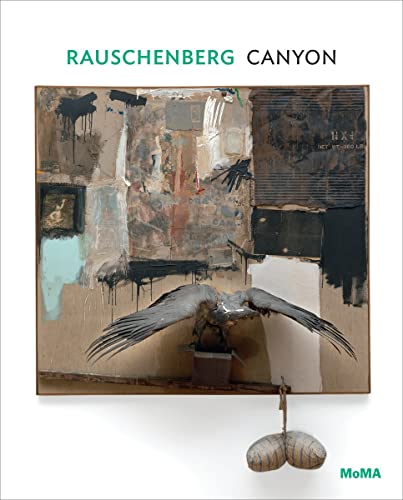
In the mid-1950s, declaring "there is no reason not to consider the world as a gigantic painting," Robert Rauschenberg began a series of radical experiments with what he called "Combines," a term he coined to describe works that fused cast-off items like quilts or rubber tires with traditional supports. "Canyon" (1959), one of the artist's best-known Combines, is a large canvas affixed with paper, fabric, metal, personal photographs, wood, mirrors and one very striking object: a large stuffed bald eagle, wings outstretched, carrying a drooping pillow, and balanced upon a wooden plank jutting out from the canvas. "Canyon" is one of six Combines in MoMA's collection, and a landmark work that helped to revolutionize art in the postwar period. An essay by curator Leah Dickerman explores the legacy of this extraordinary piece, and places it within a key period in Rauschenberg's career.Over the span of six decades, Robert Rauschenberg (1925-2008) worked in an astonishing range of mediums including painting, sculpture, prints, photography and performance. Working alone and in collaboration with artists, dancers, musicians and writers, Rauschenberg produced a vast body of work that set the course for art of the present day.
| SKU | Unavailable |
| ISBN 13 | 9780870708947 |
| ISBN 10 | 0870708945 |
| Title | Rauschenberg |
| Author | Leah Dickerman |
| Series | Moma One On One Series |
| Condition | Unavailable |
| Binding Type | Paperback |
| Publisher | Museum of Modern Art |
| Year published | 2014-01-20 |
| Number of pages | 48 |
| Cover note | Book picture is for illustrative purposes only, actual binding, cover or edition may vary. |
| Note | Unavailable |