


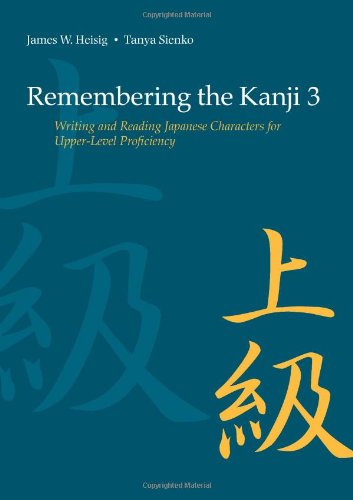
Remembering the Kanji 3 by James W Heisig
Students who have learned to read and write the basic 2,000 characters run into the same difficulty that university students in Japan face. The government-approved list of basic educational kanji is not sufficient for advanced reading and writing. Although each academic specialization requires supplementary kanji of its own, a large number of these kanji overlap. With that in mind, the same methods employed in volumes 1 and 2 of "Remembering the Kanji" have been applied to 1,000 additional characters determined as useful for upper-level proficiency, and the results published as the third volume in the series.To identify the extra 1,000 characters, frequency lists were researched and cross-checked against a number of standard Japanese kanji dictionaries. Separate parts of the book are devoted to learning the writing and reading of these characters.The writing requires only a handful of new "primitive elements." A few are introduced as compound primitives ("measure words") or as alternative forms for standard kanji. The majority of the kanji, 735 in all, are organized according to the elements introduced in Volume 1. For the reading, about twenty-five percent of the new kanji fall into "pure groups" that use a single "signal primitive" to identify the main Chinese reading. Another thirty percent of the new kanji belong to groups with one exception or to mixed groups in which the signal primitives have two readings. The remaining 306 characters are organized first according to readings that can be intuited from the meaning or dominant primitive element, and then according to useful compound terms.
James W. Heisig is professor and permanent research fellow at the Nanzan Institute for Religion and Culture in Nagoya, Japan. Tanya Sienko spent ten years working for the Japanese government and Japanese industry. After a period at the Warburg Institute in London, she returned to the U.S. and now works as an entrepreneur.
| SKU | Unavailable |
| ISBN 13 | 9780824831677 |
| ISBN 10 | 0824831675 |
| Title | Remembering the Kanji 3 |
| Author | James W Heisig |
| Condition | Unavailable |
| Binding Type | Paperback |
| Publisher | University of Hawai'i Press |
| Year published | 2008-05-15 |
| Number of pages | 440 |
| Cover note | Book picture is for illustrative purposes only, actual binding, cover or edition may vary. |
| Note | Unavailable |