
Sovereign Debt Restructuring and the Law


Sovereign Debt Restructuring and the Law
Summary
The book sheds light on the perhaps most important legal conundrum in the context of sovereign debt restructuring: the holdout creditor problem.
The feel-good place to buy books
- Free delivery in Australia
- Supporting authors with AuthorSHARE
- 100% recyclable packaging
- Proud to be a B Corp – A Business for good
- Buy-back with Ziffit
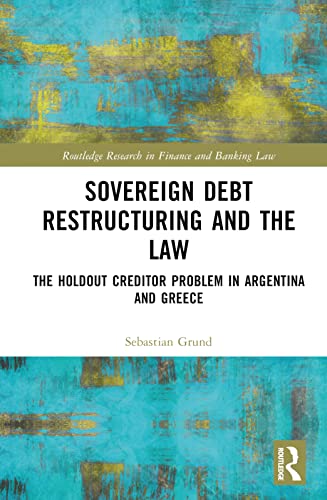
Sovereign Debt Restructuring and the Law by Sebastian Grund
The book sheds light on the perhaps most important legal conundrum in the context of sovereign debt restructuring: the holdout creditor problem. Absent an international bankruptcy regime for sovereigns, holdout creditors may delay or even thwart the efficient resolution of sovereign debt crises by leveraging contractual provisions and, in an increasing number of cases, by seeking to enforce a debt claim against the sovereign in courts or international tribunals. Following an introduction to sovereign debt and its restructuring, the book provides the first comprehensive analysis of the holdout creditor problem in the context of the two largest sovereign debt restructuring operations in history: the Argentine restructurings of 2005 and 2010 and the 2012 Greek private sector involvement. By reviewing numerous lawsuits and arbitral proceedings initiated against Argentina and Greece across a dozen different jurisdictions, it distils the organizing principles for ongoing and future cases of sovereign debt restructuring and litigation. It highlights the different approaches judges and arbitrators have adopted when dealing with holdout creditors, ranging from the denial of their contractual right to repayment on human rights grounds to leveraging the international financial infrastructure to coerce governments into meeting holdouts’ demands. To this end, it zooms in on the role the governing law plays in sovereign debt restructurings, revisits the contemporary view on sovereign immunity from suit and enforcement in the international debt context, and examines how creditor rights are balanced with the sovereign’s interest in achieving debt sustainability. Finally, it advances a new genealogy of holdouts, distinguishing between official and private sector holdouts and discussing how the proliferation of new types of uncooperative creditors may affect the sovereign debt architecture going forward. While the book is aimed at practitioners and scholars dealing with sovereign debt and its restructuring, it should also provide the general reader with the understanding of the key legal issues facing countries in debt distress. Moreover, by weaving economic, financial, and political considerations into its analysis of holdout creditor litigation and arbitration, the book also speaks to policymakers without a legal background engaged in the field of international finance and economics.No issue in sovereign finance has preoccupied the attention of scholars, politicians and lawyers in this century more than the problem of holdout creditors in sovereign debt workoutsSebastian Grund has given us a magisterial survey of how courts and arbitrators have dealt with the claims of holdout creditors in two of the largest sovereign debt restructurings in history — Argentina and Greece.
Lee Buchheit, Honorary Professor, University of Edinburgh School of Law and former Senior Partner at Cleary Gottlieb Steen & Hamilton
This book is a delightful treatment of two of the most important restructurings in the modern history of sovereign debt, Argentina and Greece. While the restructurings and the central problem of holdout creditors manifested themselves in very different ways in the different cases, Grund shows us the lessons we can learn from the commonalities. The treatment of what happened in the particular cases (and there were many) is sure to be invaluable to be both scholars and practitioners.
Mitu Gulati, Perre Bowen Professor of Law, University of Virginia School of Law
Holdout creditors are a massive impediment to the orderly restructuring of sovereign debt. They are typically investors who’ve bought the debt to profit from the sovereign debtor, not the original lenders to it. This book explores the approaches of an unusually wide range of national courts to this problem, and distils the lessons from the Argentine and Greek restructurings. It sheds light on issues that need it – as those who ultimately pay the price today of these cynical investments are the poorer citizens of poor nations.
Ross P Buckley, Scientia Professor & ARC Laureate Fellow, University of New South Wales Sydney
Sebastian Grund is a Legal Counsel at the International Monetary Fund (IMF) and previously worked at the European Central Bank (ECB) as a lawyer and economist. He holds a PhD in law from the University of Vienna and an LLM from Harvard Law School. He’s a member of the New York bar.
This book was written before his employment with the IMF, and the views expressed herein are those of the author and do not necessarily represent the views of the IMF, its Executive Board, or IMF management.
| SKU | Unavailable |
| ISBN 13 | 9781032422367 |
| ISBN 10 | 103242236X |
| Title | Sovereign Debt Restructuring and the Law |
| Author | Sebastian Grund |
| Series | Routledge Research In Finance And Banking Law |
| Condition | Unavailable |
| Binding Type | Paperback |
| Publisher | Taylor & Francis Ltd |
| Year published | 2022-12-30 |
| Number of pages | 224 |
| Cover note | Book picture is for illustrative purposes only, actual binding, cover or edition may vary. |
| Note | Unavailable |