
Student Study Guide for Life


Proud to be B-Corp
The feel-good place to buy books
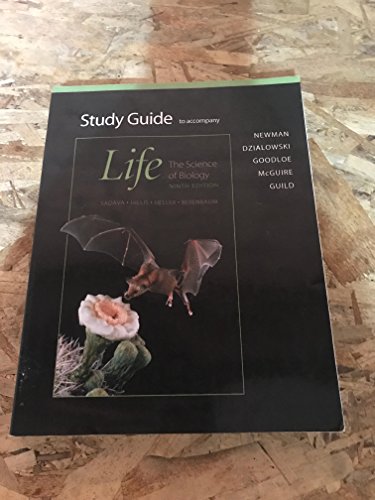
Student Study Guide for Life by David E Sadava
Revised for the Tenth Edition, the Life Study Guide offers a variety of study and review tools. The Big Picture provides the student with a quick overview of the chapter's main concepts and themes. The Study Strategies section offers suggestions for the most effective ways to study the specific material in the chapter, and points out areas students are most likely to find difficult. The Key Concept Review section incorporates a review of each main section from the chapter, with review questions that help the student apply what they have learned, including diagram questions. Each Study Guide chapter concludes with a Test Yourself section that allows the student to test their comprehension. All questions include answers and explanations.David E. Sadava is the Pritzker Family Foundation Professor of Biology, Emeritus, at the Keck Science Center of Claremont McKenna, Pitzer, and Scripps, three of The Claremont Colleges. In addition, he is Adjunct Professor of Cancer Cell Biology at the City of Hope Medical Center. Twice winner of the
Huntoon Award for superior teaching, Dr. Sadava has taught courses on introductory biology, biotechnology, biochemistry, cell biology, molecular biology, plant biology, and cancer biology. In addition to Life: The Science of Biology, he is the author or coauthor of books on cell biology and on
plants, genes, and crop biotechnology. His research has resulted in many papers coauthored with his students, on topics ranging from plant biochemistry to pharmacology of narcotic analgesics to human genetic diseases. For the past 15 years, he has investigated multi-drug resistance in human
small-cell lung carcinoma cells with a view to understanding and overcoming this clinical challenge. At the City of Hope, his current work focuses on new anti-cancer agents from plants. David M. Hillis is the Alfred W. Roark Centennial Professor in Integrative Biology at the University of Texas at Austin, where he also has directed the Center for Computational Biology and Bioinformatics and the School of Biological Sciences. Dr. Hillis has taught courses in introductory biology,
genetics, evolution, systematics, and biodiversity. He has been elected to the National Academy of Sciences and the American Academy of Arts and Sciences, awarded a John D. and Catherine T. MacArthur Fellowship, and has served as President of the Society for the Study of Evolution and of the Society
of Systematic Biologists. He served on the National Research Council committee that wrote the report BIO 2010: Transforming Undergraduate Biology Education for Research Biologists, and currently serves on the Executive Committee of the National Academies Scientific Teaching Alliance. His research
interests span much of evolutionary biology, including experimental studies of evolving viruses, empirical studies of natural molecular evolution, applications of phylogenetics, analyses of biodiversity, and evolutionary modeling. He is particularly interested in teaching and research about the
practical applications of evolutionary biology. H. Craig Heller is the Lorry I. Lokey/Business Wire Professor in Biological Sciences and Human Biology at Stanford University. He has taught in the core biology courses at Stanford since 1972 and served as Director of the Program in Human Biology, Chairman of the Biolo-gical Sciences Department, and
Associate Dean of Research. Dr. Heller is a fellow of the American Association for the Advancement of Science and a recipient of the Walter J. Gores Award for excellence in teaching and the Kenneth Cuthberson Award for Exceptional Service to Stanford University. His research is on the neurobiology
of sleep and circadian rhythms, mammalian hibernation, the regulation of body temperature, the physiology of human performance, and the neurobiology of learning. He has done research on a huge variety of animals and physiolo-gical problems, including from sleeping kangaroo rats, diving seals,
hibernating bears, photo-periodic hamsters, and exercising athletes. Dr. Heller has extended his enthusiasm for promoting active learning via the development of a two-year curriculum in human biology for the middle grades, through the production of Virtual Labs--interactive computer-based modules to
teach physiology. Sally D. Hacker is Professor at Oregon State University where she has been a faculty member since 2004. She has taught courses in introductory ecology, community ecology, invasion biology, field ecology, and marine biology. She was awarded the Murray F. Buell Award by the Ecological Society of
America and the Young Investigator Prize by the American Society of Naturalists. Dr. Hacker's research explores the structure, function, and services of natural and managed ecosystems under varying contexts of species interactions and global change. She has conducted research with plants and animals
in rocky intertidal, salt marsh, seagrass, and coastal dune ecosystems. Her work has most recently focused on the protective role of dune ecosystems in mitigating coastal vulnerability due to climate change. In addition to the textbooks Life: The Science of Biology and Ecology, she is author or
coauthor on numerous articles and book chapters exploring community ecology, species interactions, marine invasions, and ecosystem services important to coastal management. She is particularly interested in promoting active and experiential learning for students interested in ecology and
field-emersion experiences.
| SKU | Unavailable |
| ISBN 13 | 9781429235693 |
| ISBN 10 | 1429235691 |
| Title | Student Study Guide for Life |
| Author | David E Sadava |
| Condition | Unavailable |
| Binding Type | Paperback |
| Publisher | Macmillan Learning |
| Year published | 2009-12-01 |
| Number of pages | 500 |
| Cover note | Book picture is for illustrative purposes only, actual binding, cover or edition may vary. |
| Note | Unavailable |