


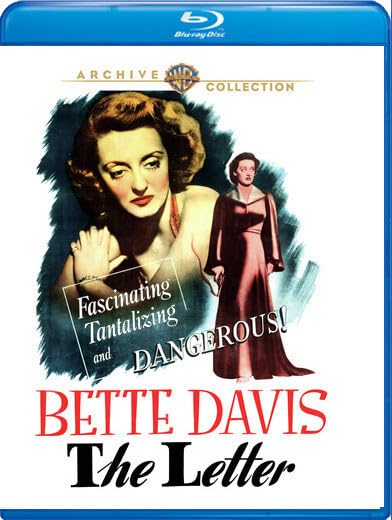
The Letter by Bette Davis
On Easter Sunday in 1873, more than one hundred black men were gunned down in Grant Parish, Louisiana, for daring to assert their right to vote. Several months earlier, in Lexington, Kentucky, another black man was denied the right to vote for simply failing to pay a poll tax. Both events typified the intense opposition to the federal guarantee of black voting rights. Both events led to landmark Supreme Court decisions. And, as Robert Goldman shows, both events have much to tell us about an America that was still deeply divided over the status of blacks during the Reconstruction era. Goldman deftly highlights the cases of United States v. Reese and United States v. Cruikshank within the context of an ongoing power struggle between state and federal authorities and the realities of being black in postwar America. Focusing especially on the so-called Reconstruction Amendments and Enforcement Acts, he argues that the decisions in Reese and Cruikshank signaled an enormous gap between guaranteed and enforced rights. The Court's decisions denied the very existence of any such guarantee and, further, conferred upon the states the right to determine who may vote and under what circumstances. In both decisions, lower court convictions were overturned through suprisingly narrrow rulings, despite the larger constitutional issues involved. In Reese the Court justified its decision by voicing only two sections of the Enforcement Acts, while in Cruikshank it merely voided the original indictments as being insufficient in law by failing to allege that the Grant Parish murders had been explicitly motivated by racial concerns. Such legalistic reasoning marked the grim beginning of a nearly century-long struggle to reclaim what the Fifteenth Amendment had supposedly guaranteed. As Goldman shows, the Court's decisions undermined the fledgling efforts of the newly formed justice department and made it increasingly difficult to control the racial violence, intimidation, poll taxes, and other less visible means used by white southern Democrats to redeem their political power. The result was a disenfranchised black society in a hostile and still segregated South. Only with the emergence of a nationwide civil rights movement and the Voting Rights Act of 1965 did things begin to change. Readable and insightful, Goldman's study offers students, scholars, and concerned citizens a strong reminder of what happens when courts refuse to enforce constitutional and legislated law--and what might happen again if we aren't vigilant in protecting the rights of all Americans.
Bette Davis was born Ruth Elizabeth Davis in Lowell, Massachusetts in 1908. After graduating from Cushing Academy, she enrolled in John Murray Anderson's Dramatic School. She made her Broadway debut in 1929, and acted in a number of theatre roles before signing to Universal Studios and later Warner Brothers Pictures. Her first film with them was Seed (1931) but the film that launched her to stardom was The Man Who Played God (1932). A string of hit films followed, including Of Human Bondage (1934) and Dangerous (1935) which won her an Oscar. Her second Oscar came in 1938, for her role as Julie in Jezebel. During the Second World War, she contributed to the war effort by selling war bonds, and in 1942 she helped to organise the Hollywood Canteen - an entertainment club for servicemen passing through Los Angeles. Her work in setting this up was recognised in 1980, when she was awarded the Distinguished Civilian Service Medal. She was highly acclaimed by critics for her performance in Now, Voyager (1942), but subsequent films during the Forties were disappointing. However, Davis made a triumphant comeback as Margo Channing in All About Eve (1950), which won her the New York Film Critics Circle Award and the Best Actress award at the Cannes Film Festival. Twelve years later, she was to have another resounding success with Whatever Happened to Baby Jane? (1962). In 1977, she was honoured with a Lifetime Achievement Award by the American Film Institute - the first time a woman had received that award. She later received the the Film Society of Lincoln Center Lifetime Achievement Award, as well as the Legion d'Honneur and the Campione d'Italia. Davis died in 1989 in in Neuilly-sur-Seine.
| SKU | Unavailable |
| EAN | 0883929692484 |
| Title | The Letter |
| Release date | 2019-09-24 |
| Format | NTSC |
| Region Code | 1 |
| Running time | 95 minutes |
| Studio | Warner Archives |
| Condition | Unavailable |
| Note | Unavailable |