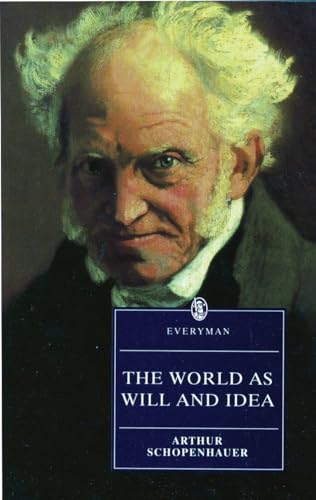
The World As Will And Idea by Arthur Schopenhauer

The World As Will And Idea by Arthur Schopenhauer

Regular price
Checking stock...
Regular price
Checking stock...
Summary

Part of the "Everyman" series which has been re-set with wide margins for notes and easy-to-read type. Each title includes a themed introduction by leading authorities on the subject, life-and-times chronology of the author, text summaries, annotated reading lists and selected criticism and notes.

The feel-good place to buy books
  • Free delivery in Australia
  • Supporting authors with AuthorSHARE
  • 100% recyclable packaging
  • Proud to be a B Corp – A Business for good
  • Buy-back with Ziffit

The World As Will And Idea by Arthur Schopenhauer

The nineteenth-century idealist philosopher and precursor of Freud The World as Will and Idea (1819) holds that all nature, including man, is the expression of an insatiable will to life; that the truest understanding of the world comes through art and the only lasting good through ascetic renunciation. Unique in western philosophy for his affinity with Eastern thought, Schopenhauer influenced philosophers, writers, and composers including Nietzsche, Wittgenstein, Wagner, Tolstoy, Thomas Mann, and Samuel Beckett. The Work presented here appeals not only to the student of philosophy but everyone interested in psychology, literature and eastern and western religion. This paperback edition is the most comprehensive available and includes an introduction, bibliography, selected criticism, index and chronology of Schopenhauer's life and times.
ARTHUR SCHOPENHAUER, the famous nineteenth-century Ger-man pessimist who expanded on the ideas of Plato and Immanuel Kant, wrote accessibly, leading his ideas to resonate with both philosophers and artists alike.

The son of Heinrich Floris Schopenhauer and Johanna Hen-riette Troisiener, Arthur was born in Danzig on February 22, 1788, just one month after English Romantic poet George Gor-don, Lord Byron. A middle-class Dutch family involved in inter-national trade, the Schopenhauers chose Arthur as their son's name because the appellation is spelled the same in English, French, and German. Once Prussia annexed Danzig in 1793, the Schopenhauer family moved first to Hamburg, then Arthur spent much of his youth living throughout Europe, learning many lan-guages. Although his father prepared him to inherit the family mercantile business, Arthur Schopenhauer found that the schol-arly life suited him perfectly. After Heinrich's 1805 death, Johanna moved her family from Hamburg to Weimar, where Johanna, an author herself, befriended the writer Johann Wolf-gang von Goethe.

Arthur Schopenhauer enrolled in the University of Gottin-gen and received his doctorate from the University of Jena in 1813. His dissertation, The Fourfold Root of the Principle of Suf-ficient Reason, explored the philosophical assumption that equates reality with rationality. According to Schopenhauer, in order for one to contemplate an explanation for a particular thing, one must assume that there is a subject (oneself) that thinks about the object (thing to be explained). Schopenhauer built his thesis on the work of Kant, who noted that humans can-not transcend themselves and therefore cannot satisfactorily answer metaphysical questions, and G. W. Leibniz, who first defined the principle of sufficient reason, which states that absolutely nothing exists that lacks an adequate reason for its existence.

Schopenhauer's most famous work, the two-volume The World as Will and Representation, sprung from ideas put forth in The Fourfold Root. Schopenhauer's philosophical inquiries led him to embrace a pessimistic worldview--life is a mean-ingless struggle against the irrational impulses of the will. One could find some solace, however, through aesthetic perception, morality, and asceticism. With regard to the first, Schopenhauer considered artistic endeavors to be the communication of Pla-tonic Ideas, with music as the highest of all art forms because of its instant objectification of the will. Schopenhauer's ideas influ-enced many literary figures--including Samuel Beckett, Joseph Conrad, Leo Tolstoy, W. B. Yeats, and Emile Zola--as well as musicians such as Johannes Brahms and Richard Wagner.

In the early 1920s, Schopenhauer began lecturing at the University of Berlin, purposely scheduling his classes concur-rent with those of G. W. F. Hegel. Schopenhauer strongly dis-liked Hegel and his philosophy; the former felt that the latter tried to make up for a lack of content in his works by ensnaring the reader in meaningless jargon.

Schopenhauer left Berlin in 1831 to escape the threat of a cholera epidemic, eventually settling in Frankfurt, where he spent the rest of his life. By the mid-1850s, Schopenhauer gained the recognition that he had longed for when a review of his philosophical work appeared in the Westminster Review, which connected some of Schopenhauer's thought with that of Johann Gottlieb Fichte. Schopenhauer's health gradually dete-riorated in 1860 until he died of natural causes on September 21 in Frankfurt. New editions of most of Schopenhauer's works began to appear in 1873.

Other works by Schopenhauer include On Vision and Col-ors (1816), On the Will in Nature (1836), The Two Fundamen-tal Problems of Ethics (1839-40), Parerga und Paralipomena (1851), and The Wisdom of Life and Counsels and Maxims (1886).

SKU Unavailable
ISBN 13 9780460875059
ISBN 10 0460875051
Title The World As Will And Idea
Author Arthur Schopenhauer
Condition Unavailable
Binding Type Paperback
Publisher Orion Publishing Co
Year published 1995-06-05
Number of pages 336
Cover note Book picture is for illustrative purposes only, actual binding, cover or edition may vary.
Note Unavailable