
The Age of Access


The Age of Access
Regular price
Checking stock...
Regular price
Checking stock...
Summary
This is an examination of how and why we are spending more and owning less. It explores the shift from markets to networks, geography to cyberspace, ownership to access relations and industrial to cultural production, and asks what the impact is on civilization.
The feel-good place to buy books
- Free delivery in Ireland
- Supporting authors with AuthorSHARE
- 100% recyclable packaging
- Proud to be a B Corp – A Business for good
- Buy-back with Ziffit
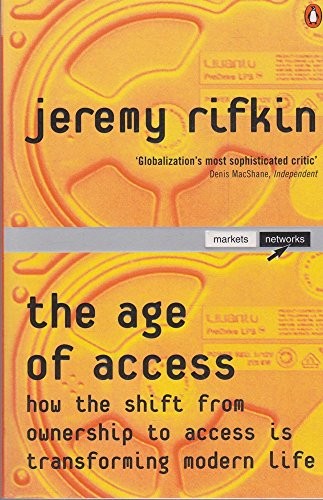
The Age of Access by Jeremy Rifkin
Imagine waking up one day to find that virtually everything you do has become a "paid for" experience. It is part of a fundamental change taking place in the nature of business, contends Jeremy Ritkin. After several hundred years as the organising principles of civilisation, the traditional market systems is beginning to break down. On the horizon looms the "age of access", where we trade experiences instead of objects. In the hypercapitalist economy - characterised by continuous innovation and dizzying speed of change -buying thongs in markets an downing property becomes an outdated idea, while "just in time" access to virtually every kind of service, through vast commercial networks operating in cyberspace, becomes the norm. We increasingly pay for the experience of using things -in the form of subscriptions, memberships and leases -rather than pay for the things themselves. The bottom line: we are spending more and owning less. Similarly, companies are selling off property, leasing equipment, outsourcing activities and becoming "weightless". Ownership of physical property, once considered a valued asset, is now regarded as a liability in the corporate world. "Lifestyle marketing" is th buzz in the commercial world as more and more consumers become members of corporate sponsored clubs and participate in corporate sponsored activities and events. The business of business, therefore, is no longer about exchanging property but, rather, buying access to one's daily existence in small commercial time-segments. In this book the author asks, will any time be left for relationships of a non-commercial nature? The changes taking place are part of an even larger transformation in the nature of capitalism. we are making a long-term shift from a system based on manufacturing goods to one based on the selling of cultural experiences. Global travel and tourism, fashion, food, sport, gambling, the virtual worlds of cyberspace and even social causes, are fast becoming the centre of an experimental economy that trades in cultural resources.
An internationally renowned social critic, Jeremy Rifkin is the best-selling author of The End of Work and The Biotech Century, both of which have been translated into fifteen languages. Rifkin is a fellow at the Wharton School Executive Education Program, where he lectures on new trends in science and technology and their impacts on the global economy, society and the environment for CEOs around the world. He is president of the Foundation on Economic Trends in Washington D.C.
| SKU | Unavailable |
| ISBN 13 | 9780140295474 |
| ISBN 10 | 014029547X |
| Title | The Age of Access |
| Author | Jeremy Rifkin |
| Series | Penguin Business Library |
| Condition | Unavailable |
| Binding Type | Paperback |
| Publisher | Penguin Books Ltd |
| Year published | 2001-05-03 |
| Number of pages | 320 |
| Cover note | Book picture is for illustrative purposes only, actual binding, cover or edition may vary. |
| Note | Unavailable |