


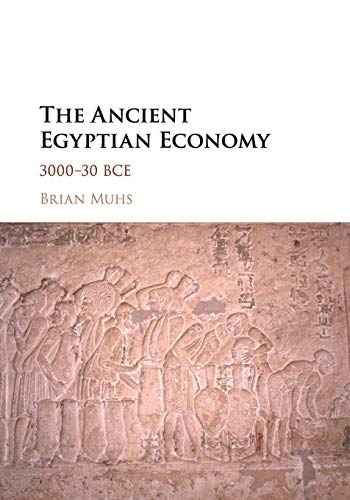
The Ancient Egyptian Economy by Brian Muhs
This book is the first economic history of ancient Egypt covering the entire pharaonic period, 3000-30 BCE, and employing a New Institutional Economics approach. It argues that the ancient Egyptian state encouraged an increasingly widespread and sophisticated use of writing through time, primarily in order to better document and more efficiently exact taxes for redistribution. The increased use of writing, however, also resulted in increased documentation and enforcement of private property titles and transfers, gradually lowering their transaction costs relative to redistribution. The book also argues that the increasing use of silver as a unified measure of value, medium of exchange, and store of wealth also lowered transaction costs for high value exchanges. The increasing use of silver in turn allowed the state to exact transfer taxes in silver, providing it with an economic incentive to further document and enforce private property titles and transfers.
Brian Muhs is Associate Professor of Egyptology at the Oriental Institute and the Department of Near Eastern Languages and Civilizations at the University of Chicago. He studies the history of ancient Egyptian social, economic, and legal institutions, particularly during the transition from pharaonic to Ptolemaic and Roman rule, and has published two books on taxation in Ptolemaic Egypt, and numerous articles.
| SKU | Unavailable |
| ISBN 13 | 9781107533950 |
| ISBN 10 | 1107533953 |
| Title | The Ancient Egyptian Economy |
| Author | Brian Muhs |
| Condition | Unavailable |
| Binding Type | Paperback |
| Publisher | Cambridge University Press |
| Year published | 2018-11-08 |
| Number of pages | 404 |
| Cover note | Book picture is for illustrative purposes only, actual binding, cover or edition may vary. |
| Note | Unavailable |