
Deep Thinking: What Mathematics Can Teach Us About The Mind


Deep Thinking: What Mathematics Can Teach Us About The Mind
Regular price
Checking stock...
Regular price
Checking stock...
Proud to be B-Corp
Our business meets the highest standards of verified social and environmental performance, public transparency and legal accountability to balance profit and purpose. In short, we care about people and the planet.
The feel-good place to buy books
- Free delivery in Ireland
- Supporting authors with AuthorSHARE
- 100% recyclable packaging
- Proud to be a B Corp – A Business for good
- Buy-back with Ziffit
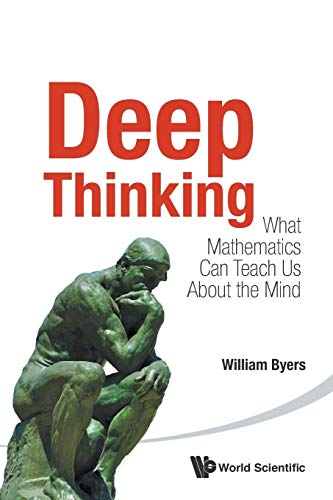
Deep Thinking: What Mathematics Can Teach Us About The Mind by William Byers
There is more than one way to think. Most people are familiar with the systematic, rule-based thinking that one finds in a mathematical proof or a computer program. But such thinking does not produce breakthroughs in mathematics and science nor is it the kind of thinking that results in significant learning. Deep thinking is a different and more basic way of using the mind. It results in the discontinuous “aha!” experience, which is the essence of creativity. It is at the heart of every paradigm shift or reframing of a problematic situation.The identification of deep thinking as the default state of the mind has the potential to reframe our current approach to technological change, education, and the nature of mathematics and science. For example, there is an unbridgeable gap between deep thinking and computer simulations of thinking. Many people suspect that such a gap exists, but find it difficult to make this intuition precise. This book identifies the way in which the authentic intelligence of deep thinking differs from the artificial intelligence of “big data” and “analytics”.Deep thinking is the essential ingredient in every significant learning experience, which leads to a new way to think about education. It is also essential to the construction of conceptual systems that are at the heart of mathematics and science, and of the technologies that shape the modern world. Deep thinking can be found whenever one conceptual system morphs into another.The sources of this study include the cognitive development of numbers in children, neuropsychology, the study of creativity, and the historical development of mathematics and science. The approach is unusual and original. It comes out of the author's lengthy experience as a mathematician, teacher, and writer of books about mathematics and science, such as How Mathematicians Think: Using Ambiguity, Contradiction, and Paradox to Create Mathematics and The Blind Spot: Science and the Crisis of Uncertainty.
William Byers is professor of mathematics at Concordia University in Montreal. He has published widely in mathematics journals.
| SKU | Unavailable |
| ISBN 13 | 9789814618038 |
| ISBN 10 | 9814618039 |
| Title | Deep Thinking: What Mathematics Can Teach Us About The Mind |
| Author | William Byers |
| Condition | Unavailable |
| Binding Type | Paperback |
| Publisher | World Scientific Publishing Co Pte Ltd |
| Year published | 2014-11-14 |
| Number of pages | 264 |
| Cover note | Book picture is for illustrative purposes only, actual binding, cover or edition may vary. |
| Note | Unavailable |