


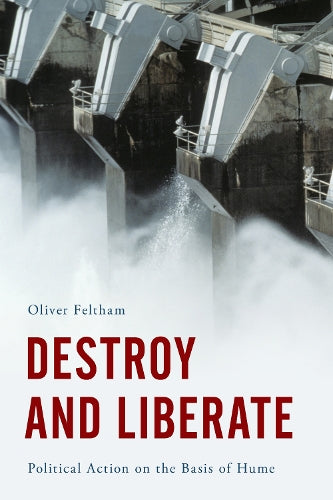
Destroy and Liberate by Oliver Feltham
In David Hume's science of human nature each and every self is located by passions that bind it to groups, repel it from other groups, and rank it on a hierarchy: we call this discovery a 'topology of passions'. These ranked selves and groups provide the matter of what he called 'government', a neutral model of political action designed to avoid the malady of faction and catapult Scotland out of feudalism into a glorious future as a commercial society. Government is to be assisted in this project by the new discipline of political economy, a discipline blind beyond its measures of privileged variables - the volume of trade, interest rates, wage levels. It is such measures that will justify the destruction of any obstacle to the commercial passions. To govern - a new kind of action for a new epoch - is to destroy and liberate. But ever since Hume governments have fallen apart because they fail to take into account the complexity of their societies as topologies of passions. It is through an analysis of Hume's account of the English Revolution in his History of England that we find an alternative to government: in his report on the impact and danger of another model of political action - democratic enthusiasm - wherein to act is to incarnate an idea of commonality. It is also in Hume's History that we discover the springs and workings of fortune in politics: models of political action woven together and unravelling only to be re-woven, any 'ought' or 'necessity' foundering in a sea of contingency. The efficacy of politics is revealed: speech acts sown together with other speech acts as they shape our experience of time.
This is a brilliant and provocative bookOliver Feltham has again demonstrated the potential of a historicisation of the foundational concepts of political philosophy for rethinking politics beyond neoliberalism. Following on from his analysis of joint action in Anatomy of Failure, in this new book Feltham opposes David Hume’s commercial model of action to the democratic enthusiasm of radical collectives in the English Revolution. The critique involves retrieval as well as demystification, however, for rather than rejecting Hume’s analysis of the political passions, Feltham advocates a topology of the passions as the key to grasping democratic political commitments. The resulting concepts of faction, envelope and vortex map the topology of the passions developed through a critical reading of Hume onto the social imaginary, breaking thereby the automatic connection between enthusiasm and sectarianism that Hume deplored. Feltham shows that the English Revolution remains a fertile reservoir of political concepts that go beyond possessive individualism and negative liberty, and that the modern era therefore harbours radical potentials that require retrieval and reactivation. -- Geoff Boucher, Associate Professor in Literary Studies, Deakin University, Australia
Oliver Feltham is Associate Professor of Philosophy at the American University of Paris.. His publications include Anatomy of Failure (2013) and Alain Badiou: Live Theory (2008). He is the translator of Alain Badiou's Being and Event (2006) and co-translator (with Justin Clemens) of Infinite Thought (2003).
| SKU | Unavailable |
| ISBN 13 | 9781783481613 |
| ISBN 10 | 1783481617 |
| Title | Destroy and Liberate |
| Author | Oliver Feltham |
| Condition | Unavailable |
| Binding Type | Paperback |
| Publisher | Rowman & Littlefield International |
| Year published | 2019-05-31 |
| Number of pages | 258 |
| Cover note | Book picture is for illustrative purposes only, actual binding, cover or edition may vary. |
| Note | Unavailable |