
Experience and Experimental Writing


Experience and Experimental Writing
Regular price
Checking stock...
Regular price
Checking stock...
Summary
Experience and Experimental Writing traces connections between the literary experiments of Emerson, Poe, Melville, and Henry James, and the emergence of classical American pragmatism.
The feel-good place to buy books
- Free delivery in Ireland
- Supporting authors with AuthorSHARE
- 100% recyclable packaging
- Proud to be a B Corp – A Business for good
- Buy-back with Ziffit
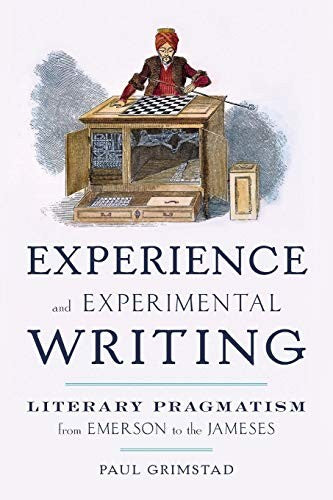
Experience and Experimental Writing by Paul Grimstad
American pragmatism is premised on the notion that to find out what something is, look to fruits rather than roots. But the thought of the classical pragmatists is itself the fruit, this book argues, of earlier literary experiments in American literature. Ralph Waldo Emerson, Edgar Allan Poe, Herman Melville, and (contemporaneously with the flowering of pragmatism) Henry James, each in their different ways prefigure at the level of literary form what emerge as the guiding ideas of classical pragmatism. Specifically, this link occurs in the way an experimental approach to composition informs the classical pragmatists' guiding and central idea that experience is not a matter of correspondence but of an ongoing attunement to the process. The link between experience and experiment is thus a way of gauging the deeper intellectual history by which literary experiments such as Emerson's Essays, Poe's invention of the detective story in "The Murders in the Rue Morgue," Melville's strange follow-up to Moby-Dick, Pierre, and Henry James's late style, find their philosophical expression in some of the guiding ideas of classical pragmatism: Charles Peirce's notion of the "abductive" inference; William James's notion of "Radical empiricism" and John Dewey's naturalist account of experience. The book frames this set of claims in relation to more contemporary debates within literary criticism and philosophy that have so far not been taken up in this context: putting Richard Poirier's account of the relation of pragmatism to literature into dialogue with Stanley Cavell's inheritance of Emerson as someone decidedly not a "pragmatist"; to the differences between classical pragmatists like William James and John Dewey and more recent, post-linguistic turn thinkers like Richard Rorty and Robert Brandom.
Grimstad's provocative book promises to retrieve the concept of experience from the disreputable position it holds in literary studies and philosophy, restoring to our critical vocabularies a word capable, in the best pragmatist fashion, of transforming our interpretive habits and stimulating new intellectual inquiries-The Los Angeles Review of Books
This is a book that deserves to be widely read. It is smart, engaging, and ambitious, and not since Cavell has Emerson been discussed with such sophistication and insight. Grimstad even manages to make the vexed notion of 'experience' appear serious again. No scholar of American philosophy and literature can afford to ignore Experience and Experimental Writing. -John Gibson, co-editor of The Literary Wittgenstein
This is a book that deserves to be widely read. It is smart, engaging, and ambitious, and not since Cavell has Emerson been discussed with such sophistication and insight. Grimstad even manages to make the vexed notion of 'experience' appear serious again. No scholar of American philosophy and literature can afford to ignore Experience and Experimental Writing. -John Gibson, co-editor of The Literary Wittgenstein
Paul Grimstad is Assistant Professor of English at Yale University.
| SKU | Unavailable |
| ISBN 13 | 9780190270049 |
| ISBN 10 | 0190270047 |
| Title | Experience and Experimental Writing |
| Author | Paul Grimstad |
| Condition | Unavailable |
| Binding Type | Paperback |
| Publisher | Oxford University Press Inc |
| Year published | 2016-05-12 |
| Number of pages | 208 |
| Cover note | Book picture is for illustrative purposes only, actual binding, cover or edition may vary. |
| Note | Unavailable |