
Friedrich Engels and the Dialectics of Nature


Friedrich Engels and the Dialectics of Nature
Proud to be B-Corp
Our business meets the highest standards of verified social and environmental performance, public transparency and legal accountability to balance profit and purpose. In short, we care about people and the planet.
The feel-good place to buy books
- Free delivery in Ireland
- Supporting authors with AuthorSHARE
- 100% recyclable packaging
- Proud to be a B Corp – A Business for good
- Buy-back with Ziffit
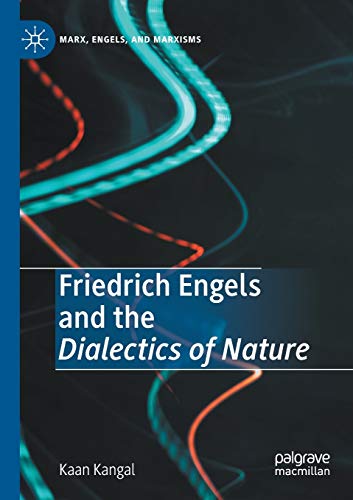
Friedrich Engels and the Dialectics of Nature by Kaan Kangal
Reading different or controversial intentions into Marx and Engels’ works has been a common but somewhat unquestioned practice in the history of Marxist scholarship. Engels’ Dialectics of Nature, a torso for some and a great book for others, is a case in point. The entire Engels debate separates into two opposite views: Engels the contaminator of Marx’s “new materialism” vs. Engels the self-educated genius of dialectical materialism. What Engels, unlike Marx, has not enjoyed so far is a critical reading that considers the relationship between different layers of this standard text: authorial, textual, editorial, and interpretational. Informed by a historical hermeneutic, this book questions the elements that structure the debate on the Dialectics of Nature. It analyzes different political and philosophical functions attached to Engels’ text, and relocates the meaning of the term “dialectics” into a more precise context. Arguing that Engels’ dialectics is less complete than we usually think it is but that he achieved more than most scholars would like to admit, this book fully documents and critically analyzes Engels’ intentions and concerns in the Dialectics of Nature, the process of writing, and its reception and edition history in order to reconstruct the solved and unsolved philosophical problems in this unfinished work.“[This book] provides an extremely knowledgeable account of the debates around Hegel’s dialectics both before and immediately after Engels’s manuscripts were written (1873–86), as well as of the successive editions of Dialectics of Nature and the debates surrounding it since its initial publication in 1925” (Daniel Gaido, Historical Materialism, historicalmaterialism.org, June 25, 2021)
“If we are to realize his aim of conceptualizing what Foster calls the ecological unity between humanity and our natural environment, we should aim to fill in the gaps in Engels’s work along the lines suggested by writers such as Collier, Sean Creaven, Foster, and Sean Sayers. Kangal has made an important contribution to this project and it behooves us to read his work to help overcome the remaining lacunae in Engels’s thought as part of the struggle for a coherent ecological alternative to capitalism’s destruction of our environment.” (Paul Blackledge, Monthly Review, April 1, 2021)
“Kaan Kangal’s new analysis of the creation and reception of Engels’ researches in the natural sciences is welcome. It helps to settle the most obvious misconceptions and false interpretations which have arisen around this posthumous work of Engels.” (Vesa Oittinen, Marx and Philosophy, marxandphilosophy.org.uk, December 15, 2020)
| SKU | Unavailable |
| ISBN 13 | 9783030343378 |
| ISBN 10 | 3030343375 |
| Title | Friedrich Engels and the Dialectics of Nature |
| Author | Kaan Kangal |
| Series | Marx Engels And Marxisms |
| Condition | Unavailable |
| Binding Type | Paperback |
| Publisher | Springer Nature Switzerland AG |
| Year published | 2021-01-28 |
| Number of pages | 213 |
| Cover note | Book picture is for illustrative purposes only, actual binding, cover or edition may vary. |
| Note | Unavailable |