
Hierarchy in International Relations


Hierarchy in International Relations
Summary
International relations are generally understood as a realm of anarchy in which countries lack any superior authority and interact within a Hobbesian state of nature. In Hierarchy in International Relations, David A. Lake challenges this traditional...
The feel-good place to buy books
- Free delivery in Ireland
- Supporting authors with AuthorSHARE
- 100% recyclable packaging
- Proud to be a B Corp – A Business for good
- Buy-back with Ziffit
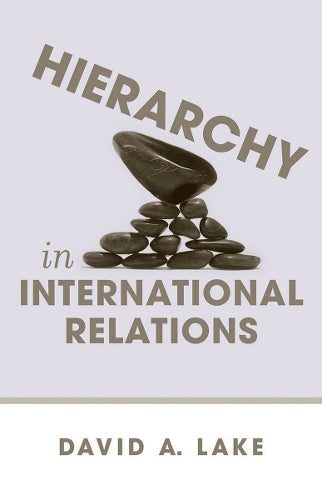
Hierarchy in International Relations by David A Lake
International relations are generally understood as a realm of anarchy in which countries lack any superior authority and interact within a Hobbesian state of nature. In Hierarchy in International Relations, David A. Lake challenges this traditional view, demonstrating that states exercise authority over one another in international hierarchies that vary historically but are still pervasive today. Revisiting the concepts of authority and sovereignty, Lake offers a novel view of international relations in which states form social contracts that bind both dominant and subordinate members. The resulting hierarchies have significant effects on the foreign policies of states as well as patterns of international conflict and cooperation. Focusing largely on U.S.-led hierarchies in the contemporary world, Lake provides a compelling account of the origins, functions, and limits of political order in the modern international system. The book is a model of clarity in theory, research design, and the use of evidence. Motivated by concerns about the declining international legitimacy of the United States following the Iraq War, Hierarchy in International Relations offers a powerful analytic perspective that has important implications for understanding America's position in the world in the years ahead.In this pioneering work, Lake argues that hierarchical relations are best seen as bargained relationships in which the dominant state provides 'services'—such as order, security, and governance—to subordinate states in return for complianceWhat distinguishes the various forms of hierarchy, from colonialism to modern alliances, is the amount of sovereignty signed over to the leading state. Lake uses this insight to explore patterns of U.S.-led hierarchy in the security and economic realms, relying on measures such as the presence of U.S. military bases, exchange-rate linkages, and trade dependence.
-- G. John Ikenberry * Foreign Affairs *David A. Lake is the Jerri-Ann and Gary E. Jacobs Professor of Social Sciences and Distinguished Professor of Political Science at the University of California, San Diego. His previous books include Power, Protection, and Free Trade: International Sources of U.S. Commercial Strategy, 1887–1939 (also from Cornell) and Entangling Relations: American Foreign Policy in Its Century, as well as eight edited or coedited volumes
| SKU | Unavailable |
| ISBN 13 | 9780801477157 |
| ISBN 10 | 0801477158 |
| Title | Hierarchy in International Relations |
| Author | David A Lake |
| Series | Cornell Studies In Political Economy |
| Condition | Unavailable |
| Binding Type | Paperback |
| Publisher | Cornell University Press |
| Year published | 2011-02-15 |
| Number of pages | 248 |
| Cover note | Book picture is for illustrative purposes only, actual binding, cover or edition may vary. |
| Note | Unavailable |