
How Physics Makes Us Free


How Physics Makes Us Free
Regular price
Checking stock...
Regular price
Checking stock...
Summary
J.T. Ismael's book will be the first to truly examine the question of what physics actually tell us about whether or not we are free to act. Her conclusions are surprising and engaging, and importantly show that physics does actually not say that we are not free.
The feel-good place to buy books
- Free delivery in Ireland
- Supporting authors with AuthorSHARE
- 100% recyclable packaging
- Proud to be a B Corp – A Business for good
- Buy-back with Ziffit
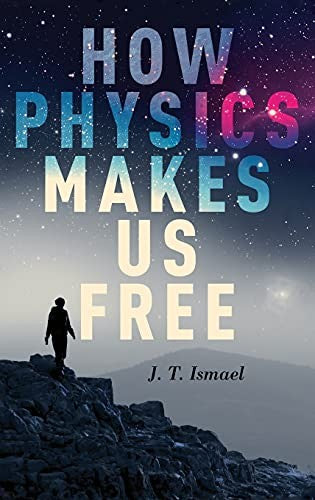
How Physics Makes Us Free by J T Ismael
In 1687 Isaac Newton ushered in a new scientific era in which laws of nature could be used to predict the movements of matter with almost perfect precision. Newton's physics also posed a profound challenge to our self-understanding, however, for the very same laws that keep airplanes in the air and rivers flowing downhill tell us that it is in principle possible to predict what each of us will do every second of our entire lives, given the early conditions of the universe. Can it really be that even while you toss and turn late at night in the throes of an important decision and it seems like the scales of fate hang in the balance, that your decision is a foregone conclusion? Can it really be that everything you have done and everything you ever will do is determined by facts that were in place long before you were born? This problem is one of the staples of philosophical discussion. It is discussed by everyone from freshman in their first philosophy class, to theoretical physicists in bars after conferences. And yet there is no topic that remains more unsettling, and less well understood. If you want to get behind the façade, past the bare statement of determinism, and really try to understand what physics is telling us in its own terms, read this book. The problem of free will raises all kinds of questions. What does it mean to make a decision, and what does it mean to say that our actions are determined? What are laws of nature? What are causes? What sorts of things are we, when viewed through the lenses of physics, and how do we fit into the natural order? Ismael provides a deeply informed account of what physics tells us about ourselves. The result is a vision that is abstract, alien, illuminating, and-Ismael argues-affirmative of most of what we all believe about our own freedom. Written in a jargon-free style, How Physics Makes Us Free provides an accessible and innovative take on a central question of human existence.
Jenann Ismael's book is a strikingly original monograph that somehow manages to be perfectly relevant and highly engaging to both the intelligent lay reader and the professional philosopherIt shows how well done philosophy of science can be relevant for the public at large, even when treating questions that have, of late, suffered from the ravages of analytic metaphysics. The book may be more widely read inside the academy than outside, but those on the outside who read it in full will surely come away with a better opinion of philosophy than they had at the start. Ismael's prose is beautiful, evocative, and full of helpful metaphors and analogies ... It is a book that nobody who cares about how human freedom squares with modern physicalism can afford to ignore. * Carl Hoefer, Notre Dame Philosophical Reviews Online *
[a] very welcome contribution to this literature. * John Maier, Australasian Journal of Philosophy. *
[a] very welcome contribution to this literature. * John Maier, Australasian Journal of Philosophy. *
J.T. Ismael is Professor of Philosophy at the University of Arizona. She is the author of The Situated Self (OUP, 2007) and Essays on Symmetry (2001).
| SKU | Unavailable |
| ISBN 13 | 9780190269449 |
| ISBN 10 | 0190269448 |
| Title | How Physics Makes Us Free |
| Author | J T Ismael |
| Condition | Unavailable |
| Publisher | Oxford University Press Inc |
| Year published | 2016-03-24 |
| Number of pages | 288 |
| Cover note | Book picture is for illustrative purposes only, actual binding, cover or edition may vary. |
| Note | Unavailable |