
Introduction to Boolean Algebras


Summary
The feel-good place to buy books
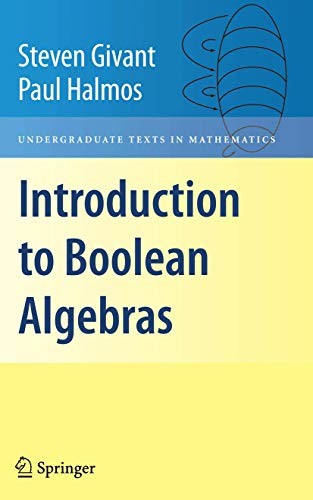
Introduction to Boolean Algebras by Steven Givant
This book is an informal though systematic series of lectures on Boolean algebras. It contains background chapters on topology and continuous functions and includes hundreds of exercises as well as a solutions manual.From the reviews:
“This is an excellent and much-needed comprehensive undergraduate textbook on Boolean algebrasIt contains a complete and thorough introduction to the fundamental theory of Boolean algebras. Aimed at undergraduate mathematics students, the book is, in the first author’s words, “a substantially revised version of Paul Halmos’ “Lectures on Boolean Algebras.” It certainly achieves its stated goal of “steering a middle course between the elementary arithmetic aspects of the subject” and “the deeper mathematical aspects of the theory” of Boolean algebras.”
…
“The book is written for undergraduate students who already have skills in proving theorems. However, since the proofs are so detailed and clear, it could work well as a text for a second or even first course involving substantial proofs. For this reason, it would also make a great book for a student doing independent study. The text is somewhat informal in the sense that sometimes proofs appear in the prose rather than under the heading, “Proof”, but it is always clear when this is being done. Though the book starts with an introduction to Boolean rings, knowledge of group theory or rings is not a prerequisite for using the book.”
…
“In summary, “Introduction to Boolean algebras” is a gem of a text which fills a long-standing gap in the undergraduate literature. It combines the best of both worlds by rigorously covering all the fundamental theorems and topics of Boolean algebra while at the same time being easy to read, detailed, and well-paced for undergraduate students. It is my most highly recommendedtext for undergraduates studying Boolean algebras.”
(Natasha Dobrinen. The Bulletin of Symbolic Logic, Vol. 16 (2), June 2010: 281-282)
"Introduction to Boolean Algebras … is intended for advanced undergraduates. Givant (Mills College) and Halmos … using clear and precise prose, build the abstract theory of Boolean rings and algebras from scratch. … the necessary topological material is developed within the book and an appendix on set theory is included. … Includes an extensive bibliography and more than 800 exercises at all levels of difficulty. Summing Up: Highly recommended. Upper-division undergraduates, graduate students, researchers, and faculty." (S. J. Colley, Choice, Vol. 46 (10), June 2009)
“The authors have written a book for advanced undergraduates and beginning graduate students. … The authors start with the definition of Boolean rings and Boolean algebras, give examples and basic facts and compare both notions. … There are a large number of exercises of varying level of difficulty. Hints for the solutions of the harder problems are given in an appendix. A detailed solutions manual for all exercises is available for instructors. The book can serve as a basis for a variety of courses.” (Martin Weese, Zentralblatt MATH, Vol. 1168, 2009)Paul R. was born in Hungary and grew up in the United States. Halmos (1916-2006) was highly regarded as a brilliant mathematician. He made substantial contributions to numerous fields of mathematics, including mathematical logic, probability theory, ergodic theory, and functional analysis, while teaching at the University of Chicago and other universities.
| SKU | Unavailable |
| ISBN 13 | 9780387402932 |
| ISBN 10 | 0387402934 |
| Title | Introduction to Boolean Algebras |
| Author | Steven Givant |
| Series | Undergraduate Texts In Mathematics |
| Condition | Unavailable |
| Binding Type | Hardback |
| Publisher | Springer-Verlag New York Inc. |
| Year published | 2008-12-02 |
| Number of pages | 574 |
| Cover note | Book picture is for illustrative purposes only, actual binding, cover or edition may vary. |
| Note | Unavailable |