


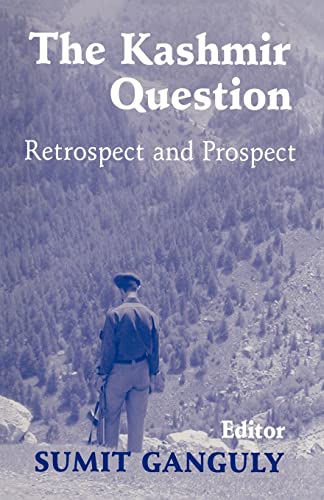
The Kashmir Question by Sumit Ganguly
India, which had been created as a civic polity, initially sought to hold on to this Muslim-majority state to demonstrate its secular credentials. Pakistan, in turn, had laid claim to Kashmir because it had been created as the homeland for the Muslims of South Asia. After the break-up of Pakistan in 1971 the Pakistani irredentist claim to Kashmir lost substantial ground. If Pakistan could not cohere on the basis of religion alone it had few moral claims on its co-religionists in Kashmir. Similarly, in the 1980s, as the practice of Indian secularism was eroded, India's claim to Kashmir on the grounds of secularism largely came apart. Today their respective claims to Kashmir are mostly on the basis of statecraft. This title provides a comprehensive assessment of a number of different facets of the on-going dispute over Kashmir between India and Pakistan. Among other matters, it examines the respective endgames of both states, the evolution of American policy toward the dispute, the dangers of nuclear esculation in the region and the state of the insurgency in the Indian-controlled portion of the disputed state.
Sumit Ganguly is professor of Asian studies and government at the University of Texas at Austin. He has been a fellow and a guest scholar at the Woodrow Wilson International Center for Scholars and a fellow at the Center for International Security and Cooperation at Stanford University. His previous books include The Crisis in Kashmir: Portents of War, Hopes of Peace.
| SKU | Unavailable |
| ISBN 13 | 9780714684390 |
| ISBN 10 | 0714684392 |
| Title | The Kashmir Question |
| Author | Sumit Ganguly |
| Condition | Unavailable |
| Binding Type | Paperback |
| Publisher | Routledge |
| Year published | 2003-07-01 |
| Number of pages | 226 |
| Cover note | Book picture is for illustrative purposes only, actual binding, cover or edition may vary. |
| Note | Unavailable |